The Faint Light Every Living Thing Gives Off — and What It May Be Telling Us

There's a news story making the rounds about a discovery of "tiny messages" given off by living things.
A joint research team from the University of Calgary and the National Research Council of Canada managed to actually photograph a form of light that's normally invisible to us.
Using a specialized camera, they captured the extremely faint glow given off by mice and plants.
They observed that this light grows stronger when the organism is under stress, and that it fades away rapidly at the moment of death.
The findings were published on April 24, 2025, in the scientific journal The Journal of Physical Chemistry Letters.
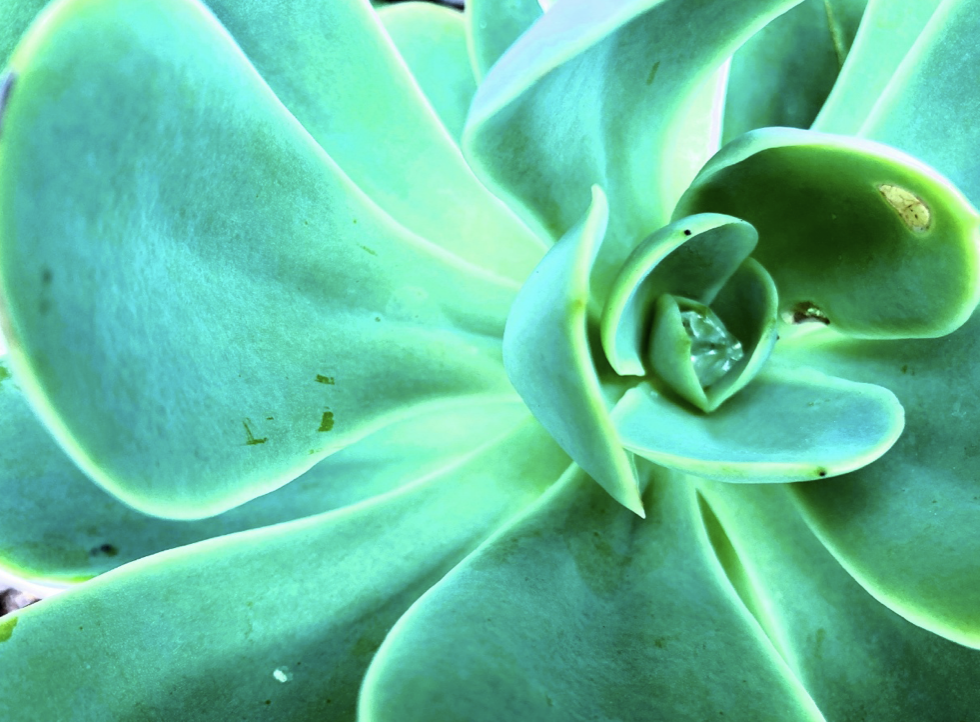
Plants can't speak, and yet, along with animals and humans, they turn out to be giving off a strange light too faint for our eyes to see on their own.
In plants specifically, the intensity of this light increases under stress — a shift in temperature, a damaged leaf.
The rise and fall in that glow appears to reflect something about the organism's physical and internal state, a kind of tiny message written in light.
It's a genuinely fascinating idea.
If this line of research keeps advancing, there may come a day when we can read the health of a person, an animal, or a plant simply by analyzing the light they give off.
The potential applications reach well beyond medicine, into agriculture and horticulture as well.
It's the kind of story about the mysterious light of living things that sounds like it belongs in fantasy or the occult.
If you're curious, the original research write-up is well worth a look.
The plant pictured here is Echeveria, a popular succulent in the Crassulaceae family, native to Mexico and the northwestern reaches of Central and South America.
Its thick, glossy leaves fan out in a rosette so smooth it almost looks like it's giving off light of its own.
There are countless Echeveria varieties to choose from.
Next time you're picking one out, it might be worth imagining the faint light every plant is quietly giving off, whether we can see it or not.
We spend our days close to plants across Mie Prefecture, Japan, watching for the quieter signs of stress and health that don't always show up right away. If you'd like a second pair of eyes on your garden, get in touch.