


Fukiran Was Blooming on a Tree We Were Asked to Fell: Edo Orchid Culture and Neofinetia falcata

URLスラッグ: fukiran-neofinetia-falcata-edo-orchid-culture
Some time ago, we were asked to fell a tree in a client's garden.
On its trunk, white flowers were blooming.
Slender leaves spread like a fan, and the roots were wrapped around the bark. The plant was not growing in soil. It was living on the tree itself.

It was fuuran, the wind orchid. In the world of Japanese horticulture it is also called fukiran, the orchid of wealth and nobility. Its botanical name is Neofinetia falcata, now often treated as Vanda falcata.
Felling a tree means taking charge of the whole life of that tree. So before we cut, we always look carefully at the trunk. This time, the trunk was carrying someone's feelings.
Where did this orchid come from?
Fuuran is an epiphytic orchid that grows wild in low mountains west of the Kanto region. Mie Prefecture lies within its range. So it is not impossible that a seed drifted in on the wind and settled on the tree by itself.
But seeing the plant gathered in one clump and flowering so well, I could not help thinking that the owner loved it and had attached it to the trunk. I cannot say for certain.
What I can say is that the culture of growing fuuran on garden trees goes back a very long way.
The people of Edo were crazy about this orchid
The cultivation of fuuran began in the Genroku era of the early Edo period, between 1688 and 1704.
Ito Ihei Sannojo, a nurseryman from Somei in Edo, introduced fuuran in the orchid section of his gardening book Kadan Jikinsho, published in 1695.
He wrote that the roots should be wrapped in bamboo sheath or palm fiber and hung in the air, because the plant thrives when it catches the wind.
The name fuuran, wind orchid, comes from this way of growing it: in the wind.
In time, this orchid moved even a shogun.
The eleventh shogun, Tokugawa Ienari, is said to have been a passionate lover of fuuran and to have built growing shelves inside Edo Castle.
Feudal lords searched their domains for unusual plants and presented them to the shogun when they traveled to Edo. When viewing them, people covered the plants with wire-mesh baskets so as not to touch them directly, and held white paper in their mouths so their breath would not reach the leaves. It was treated with that much care.
Toward the end of the Edo period, in the Kaei era between 1848 and 1855, plants with unusual leaves and flowers became a craze.
Ranking charts were even made, modeled on the banzuke rankings of sumo wrestlers.
Variegated and other horticultural forms of fuuran are given the elegant name fukiran. In the same way, the orchid Dendrobium moniliforme was called chouseiran, the orchid of long life.
Specialist books recorded the variations in drawings.
Somoku Kinyoshu, by the hatamoto samurai Mizuno Tadanori, was published in 1829.
More than a thousand variegated plants were painted in color by artists such as Sekine Untei. In fukiran, we know that even the way the color changed at the tips of the aerial roots was something to admire.
In other words, the practice of letting an orchid live on a tree and loving it there has deep roots in the history of Japanese gardens.
The quiet strategy of fuuran
Fuuran is an epiphytic orchid that was long treated as the only species of its own genus, Neofinetia; recent DNA studies place it in the genus Vanda. It attaches to the thin branches of deciduous trees. In summer it spends its days in the shade of the leaves, and from winter to early spring it takes strong sunlight on bare branches. It lives in step with the breathing of the tree through the year.
The flowers are white and become strongly fragrant at night. The sweet scent is often compared to vanilla or honeysuckle.
Its most striking feature is the spur that hangs long and downward from the base of each flower.
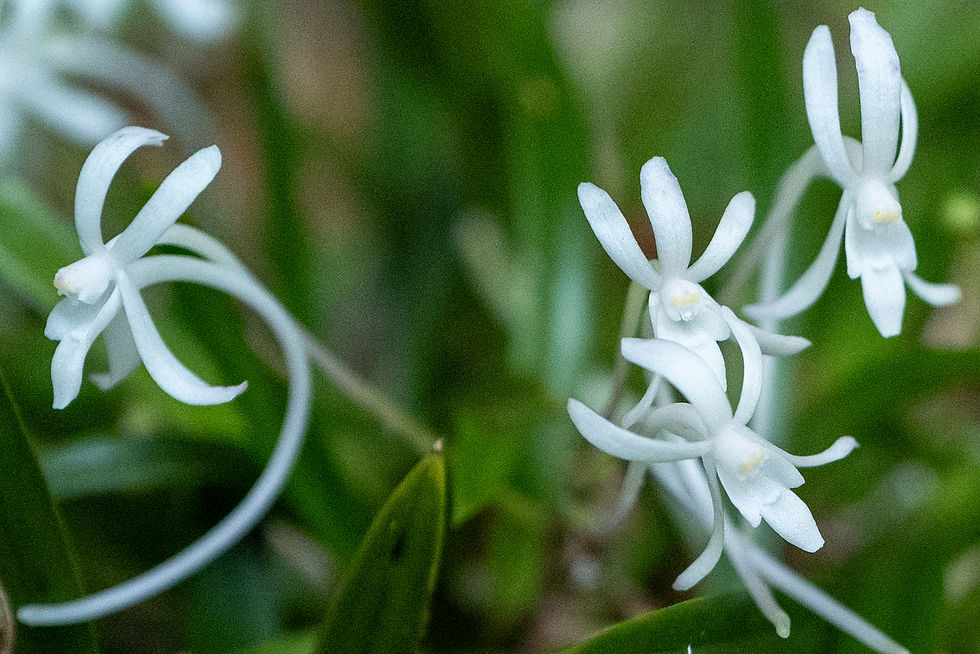
A spur is a slender tube that holds nectar. Most of fuuran's relatives have short spurs, but fuuran's alone is exceptionally long. There is a reason for this length.
A 2015 study by Kenji Suetsugu and colleagues showed that small hawkmoths of the genus Theretra, whose long tongues match this long spur, visit the flowers and are the likely pollinators that carry fuuran's pollen.
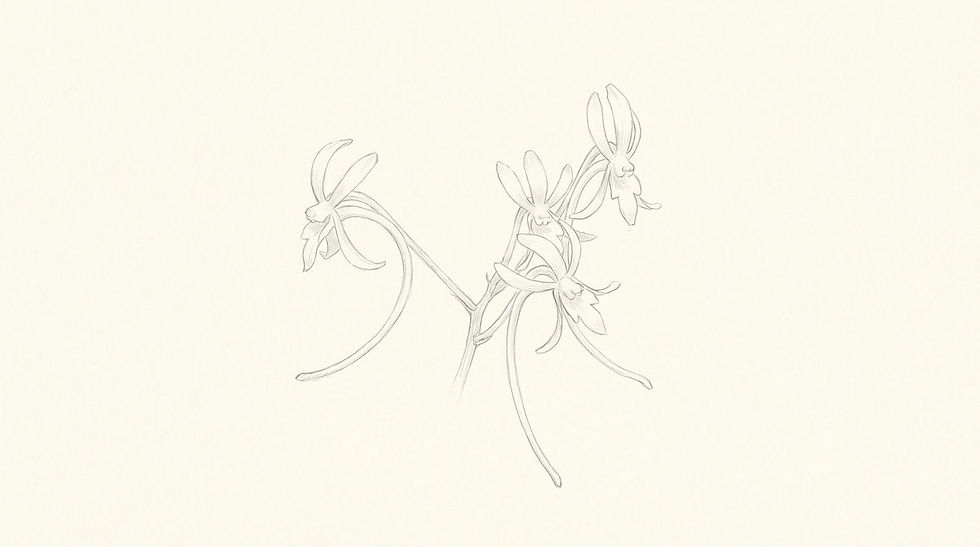
Fragrant at night. White flowers. A long spur. These are not three separate features.
Together they form one consistent system for letting night-flying hawkmoths drink the nectar and carry the pollen. Not control, but a relationship.
Fuuran became what it is through a long partnership with a single kind of moth.
Before you fell a tree, please look up once more
In our work, we sometimes meet epiphytes such as fuuran, sekkoku (Dendrobium moniliforme) and nokishinobu (a small epiphytic fern). In those cases, the plant often carries the owner's affection.
So before we cut, we ask. If the owner wishes, we can remove the plant carefully without damaging it and move it to another tree.

The way to move it is just as the Edo records say.
Wrap the roots in palm fiber or tree fern, and let the wind and light pass through.
Words written by a nurseryman three hundred years ago are still alive on our job sites today.
Felling a tree is not simply getting rid of a tree. It also means carrying on the time that lived in that tree, and someone's feelings along with it.
When I looked up at the sky, a white orchid was swaying in the wind at the very top of the tree. Now we will look for the next place where it can bloom.
Main sources
Kadan Jikinsho (1695): Engei Net, fuuran growing guide
Tokugawa Ienari and the manners of cultivation: Japan Traditional Horticulture Association
The names fukiran and chouseiran: Chuetsu Botanical Garden
Somoku Kinyoshu, Mizuno Tadanori, 1829: National Archives of Japan
Ecology and night fragrance: American Orchid Society
Hawkmoth pollination: Suetsugu K., Tanaka K., Okuyama Y. and Yukawa T. 2015, European Journal of Entomology 112. PDF


