Tall Goldenrod in Japan: How a North American Wildflower Became an Invasive Weed

In Kentucky and Nebraska, goldenrod is the state flower. In Japan, the same golden plumes that line riverbanks every October are usually called a weed, and an invasive one.
We are a small tree care and landscape business in Mie Prefecture, central Japan. We work in gardens, bamboo groves and satoyama, the managed countryside between village and forest. Tall goldenrod is a plant we meet almost everywhere we work. This page explains how one plant can be loved on one continent and fought on another.
What the Japanese name means
In Japanese the plant is called seitaka-awadachisō. Seitaka means "tall". Awadachisō is an old name for Japan's native goldenrod, Solidago virgaurea subsp. asiatica, a small autumn wildflower of mountain meadows. So the name simply says "the tall goldenrod", which is close to the English name.
The newcomer took the name of a modest native relative, and then grew far larger than it.
The plant itself
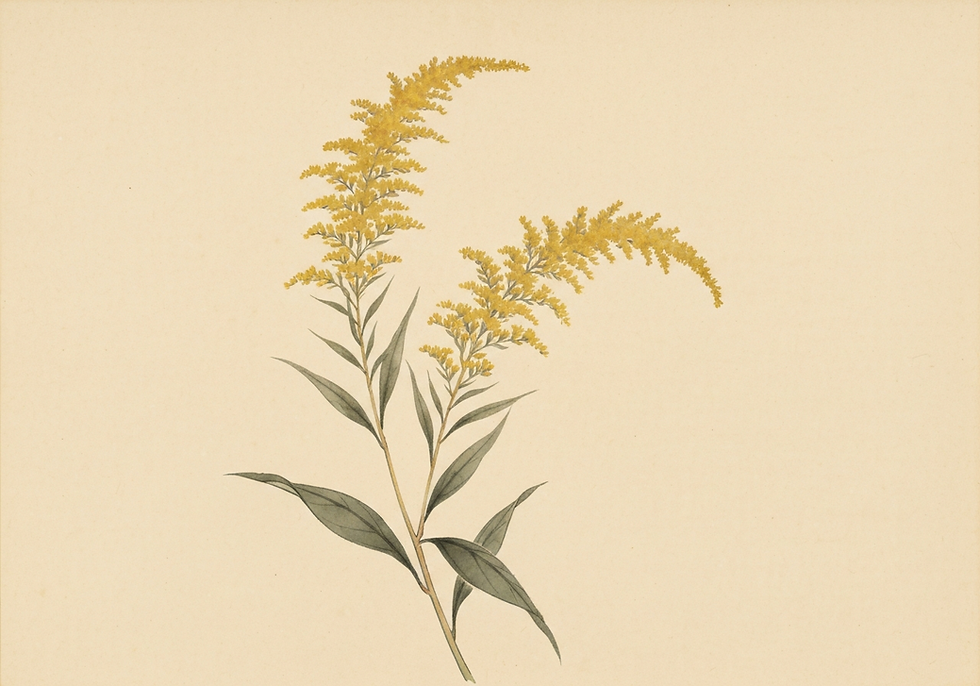
Tall goldenrod (Solidago altissima) is a perennial in the aster family, native to North America. In Japan its stems reach 1 to 2.5 metres. It flowers from late summer to November, with many small yellow heads on arching, cone-shaped clusters. It spreads underground by long rhizomes, so one plant soon becomes a dense stand.
It grows on riverbanks, embankments, wasteland, fallow fields and roadsides. In other words, it grows where the ground has been disturbed by people.
How it arrived and spread
According to the invasive species database of Japan's National Institute for Environmental Studies (NIES), tall goldenrod was brought to Japan around 1900 as an ornamental plant and as a source of nectar for honeybees. It stayed quiet for decades. After the Second World War, as rivers were straightened, land was cleared and fields were left fallow, it spread across almost the whole country.
Today it is listed among the 100 worst invasive alien species in Japan.
Allelopathy: the chemical weapon
Part of its success is allelopathy. The roots and rhizomes release compounds, including cis-dehydromatricaria ester (cis-DME), that hold back the germination and growth of nearby plants. Where tall goldenrod settles, other plants struggle to come back.
There is a twist that Japanese naturalists like to tell. In very dense stands, the plant is said to be held back by its own chemicals too. The weapon that cleared the ground starts to work against its owner.

Susuki grass comes back
In Japan, the plant on the other side of this story is susuki, Japanese pampas grass (Miscanthus sinensis). Susuki is a symbol of autumn here. It is the grass people place beside rice dumplings at the autumn moon-viewing, tsukimi.
The NIES database notes that, from around 1980, many goldenrod stands began to give way to native ogi (Miscanthus sacchariflorus) and susuki as plant succession moved on, and that a rise in insects and diseases that attack goldenrod may also be weakening it. In the countryside you can now often see goldenrod and susuki growing mixed together. It is a slow contest that is still going on.
It is not the cause of hay fever
In Japan, as in North America, goldenrod is often blamed for autumn hay fever. But goldenrod is pollinated by insects. Its pollen is heavy and sticky and is not carried far by the wind. The usual cause is ragweed, a wind-pollinated plant that flowers at the same time in the same places. Ragweed also came to Japan from North America.
Not only a weed
The same database notes that tall goldenrod is a source of honey and gives shelter to birds and other animals. Some people in Japan dry the stems and leaves and put them in the bath for the colour and the scent. In North America, goldenrods have long been used by Indigenous peoples.
So the plant is not simply good or bad. It depends on where it grows and what it has replaced.
What we see in our work
In gardens and in the satoyama we care for, we see thick tall goldenrod as a record of the land. It tells us that the ground was cleared, dug or left at some point. Pulling it out without asking why it is there tells you nothing about the place.
When it does need to be controlled, the NIES database lists pulling and mowing at least twice a year. In our experience, the most useful question comes before the cutting: what will grow here once the goldenrod is gone?
A wildflower in Kentucky, a weed in Mie. The plant is the same. What changed is the land it arrived in, and the people who made room for it.