Why Old Satoyama Trees Were Never Cut Down — The Underground Network Science Later Proved Was Real

Working in satoyama, I keep noticing the same thing near almost every village.
There's always one big tree left standing.
A cedar in the shrine grounds.
A huge oak at the edge of a rice paddy.
A zelkova by the water.
Most of these are trees people chose, deliberately, not to cut.
Nobody alive today can tell us exactly why the original decision was made.
But modern science has slowly been filling in the answer.
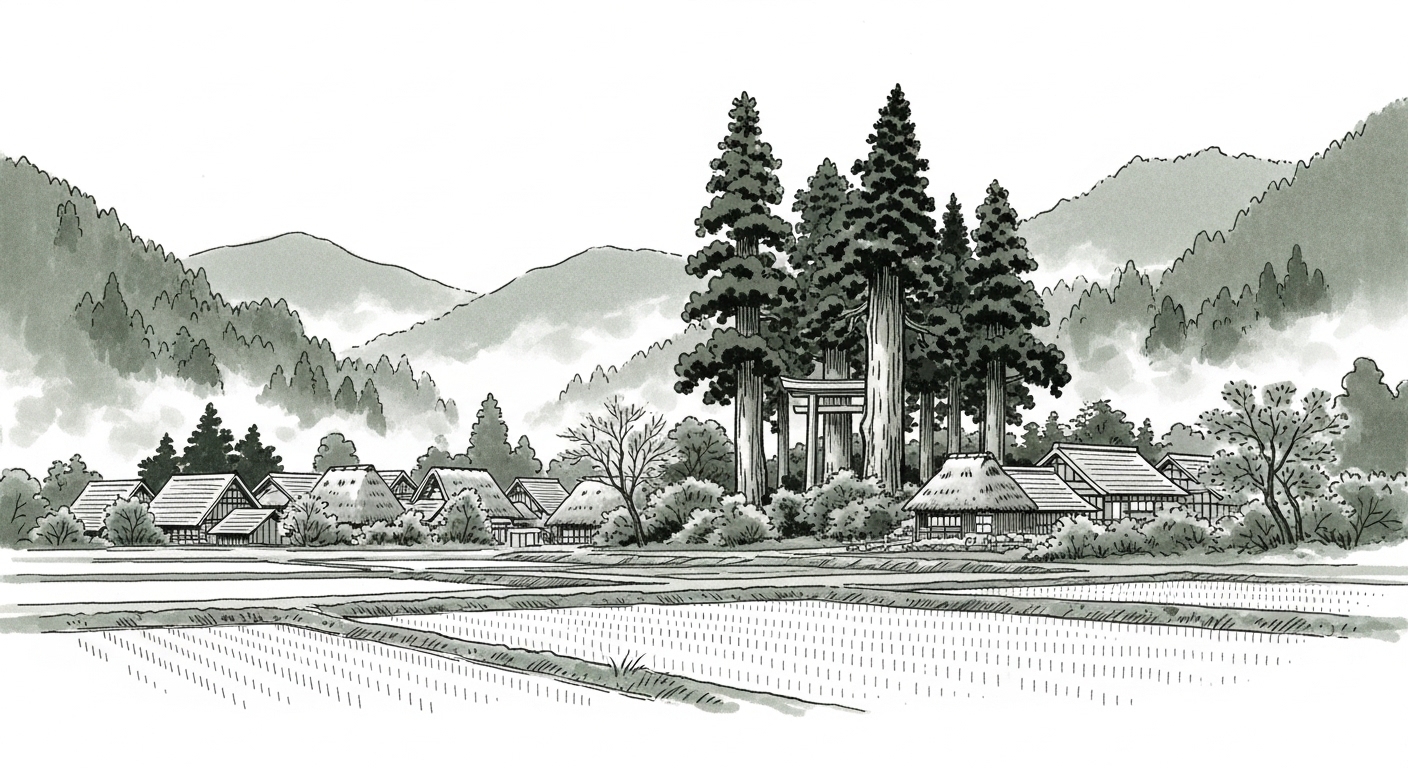
In villages across Japan, there's a persistent belief that cutting one of these big trees brings misfortune.
Sacred trees, protected as goshinboku, exist all over the country.
Researchers today don't see this as superstition.
They see it as ecological knowledge, built up over generations of observation, that eventually took the shape of a belief system.
There's a related saying: cut the big tree, and the water dries up.
That one turns out to be literally true.
A large tree with deep roots holds soil in place and guides rainwater down into the ground.
Modern hydrology confirms this function directly.
Trees are connected underground.
In 1997, the Canadian forest ecologist Suzanne Simard published a paper in Nature.
It showed that Douglas fir trees were transferring carbon to each other through soil fungi — specifically, ectomycorrhizal fungi.
Above ground, trees look like separate individuals.
Underground, they're connected through a network of mycorrhizal fungi.
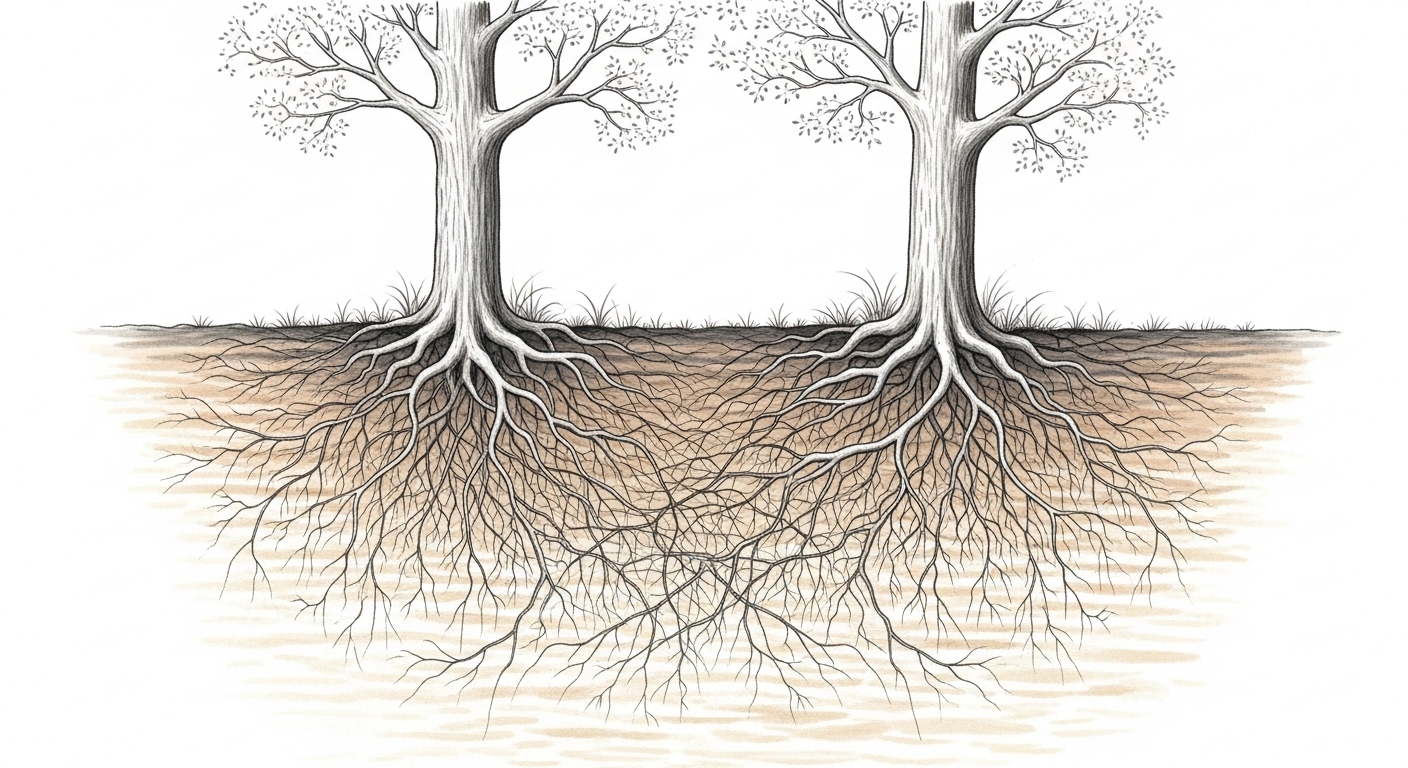
That network later picked up a nickname: the wood wide web.
Mycorrhizal fungi live in partnership with tree roots and build a vast underground network.
Through it, trees exchange sugar, phosphorus, and nitrogen with each other.
The finding has been confirmed repeatedly in the research since, and it's now considered essential to understanding how a forest actually functions.
What stood out most in Simard's research was the role of the oldest, biggest trees — what she called mother trees.
A large old tree functions as a hub at the center of the mycorrhizal network.
It was shown to send nutrients preferentially to the younger trees and seedlings around it.
It sends even more to seedlings of its own species.
A big tree isn't just alive for its own sake.
It works, quietly, as a hub supporting the next generation growing up around it — carrying the regeneration of the whole forest on its back.
In villages where people kept these old trees standing, that hub likely kept functioning, generation after generation, which may be part of why satoyama vegetation there stayed so stable.
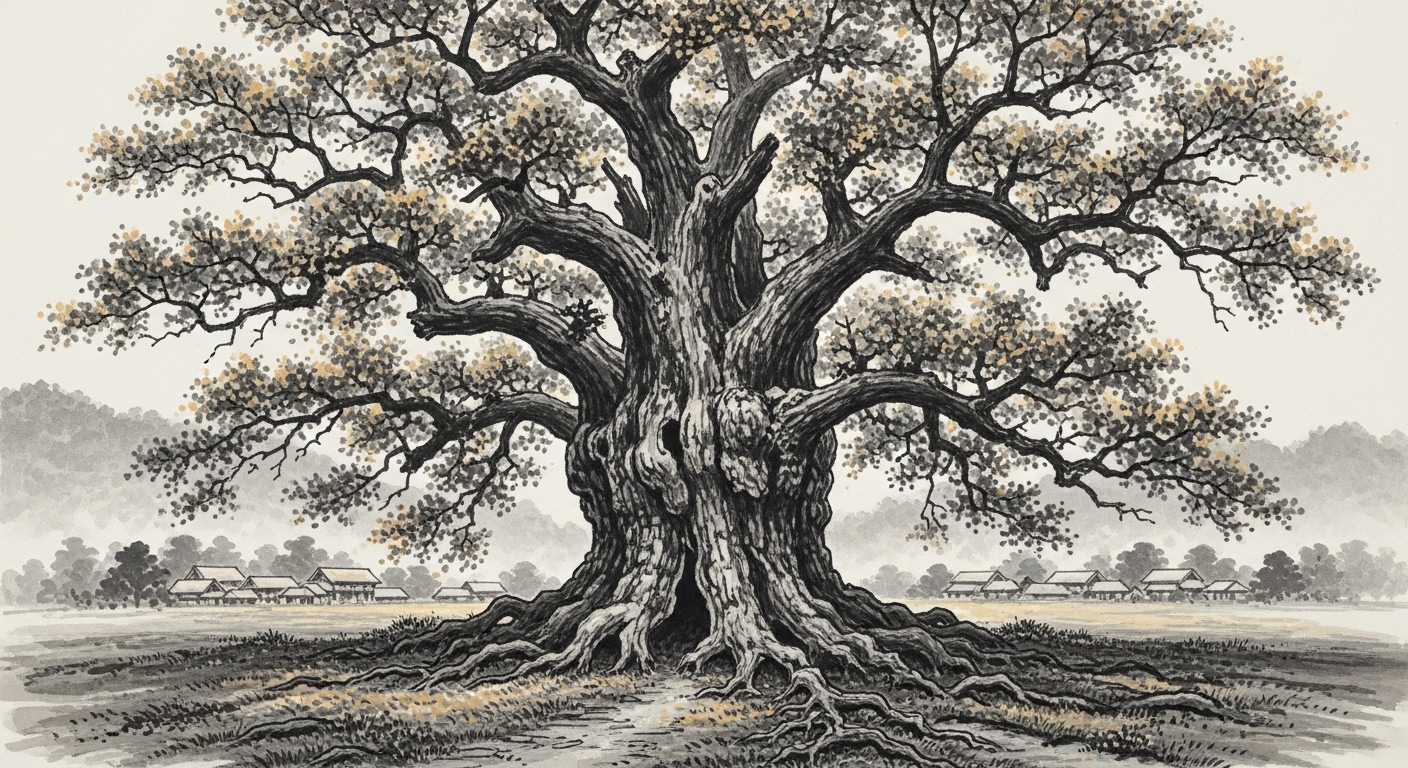
What about a big old tree in a garden?
A large tree in a garden takes work.
Fallen leaves, shade, roots pushing up through the ground.
Even so, that tree is functioning as a hub in a mycorrhizal network.
Plenty of people have had the experience of planting a young tree after removing an old one, only to watch it struggle to establish.
Removing a tree roots and all is very different, underground, from simply managing what grows above the soil.
The ecologically sound way to think about an old tree isn't just about its branches and canopy.
It's about the underground network the tree has been part of, possibly for decades before you ever saw it.
A quick technical note, for anyone curious.
Mycorrhizal fungi come in two broad types.
Arbuscular mycorrhizal fungi (AMF) live inside root cells.
Ectomycorrhizal fungi (ECM) form a sheath around the outside of the root instead.
Many of the trees common in satoyama — oak, beech, pine — are the ECM type, and this type is known for an especially well-developed nutrient-exchange network.
Simard's original research was done on Douglas fir, which is also ECM.
A few questions we hear often.
If you're removing an old tree from a garden, does it matter how you do it?
Yes.
Whether the roots are left in the ground or removed entirely changes how much the surrounding mycorrhizal network is disrupted.
Where removal is unavoidable, leaving some of the root system in place tends to affect the neighboring network less than clearing everything out.
Should you think about mycorrhizal fungi when planting a young tree?
Most commercial potting soil doesn't contain any.
A newly planted tree can sit disconnected from the local network for a while as a result.
Planting close to the root zone of an existing large tree, or using a mycorrhizal inoculant, both tend to help a young tree establish faster.
What about thinning trees in satoyama itself?
Selective cutting — removing some trees while leaving others — disturbs the mycorrhizal network far less than clear-cutting.
The trees left standing are then better able to keep supporting the younger growth around them.
Where we can, we try to keep as many of the existing broadleaf trees in place as the work allows.
We manage satoyama and garden trees across Mie Prefecture, Japan, with this kind of underground relationship in mind. If you're considering the future of an old tree, get in touch.