


Sweetgum in Japan: Autumn Street Trees in Three Colours, and the Roots That Lift the Pavement

In late November, many streets and parks in Japan turn three colours at once. On a single tree you can see green, yellow and deep red leaves side by side. Very often that tree is not a Japanese maple at all, but an American one: the sweetgum, Liquidambar styraciflua.
We are a small tree care and landscape business in Mie Prefecture, central Japan. This page is based on our Japanese article about the sweetgum as a street tree, with more background for readers outside Japan.

A maple leaf name for an American tree
In Japanese the tree is called momijibafu, which means "the fu with maple like leaves". Fu is the old name for a related Asian tree, Liquidambar formosana, from China and Taiwan, whose leaves have three lobes. The American sweetgum has five to seven lobes, like a maple, and that is where the name comes from. It is also called amerika fu, the American fu.
The tree is native to eastern North America and Central America. Japanese botanical gardens say it came to Japan in the Taisho era, between 1912 and 1926. Today it is one of the familiar street and park trees of Japanese towns. It takes both summer heat and winter cold, which suits public planting, but it can grow to around 20 metres in a city and much taller in the wild, so it is rarely a good choice for a small home garden.
Spiky balls and a short season
The flowers have no petals and open around May. Male and female flowers grow on the same tree. The fruit becomes a hard, spiky ball about 3 centimetres across, which hangs on a long stalk and often stays on the branches after the leaves have fallen. In Japan the fallen balls are popular for winter wreaths and craft work, together with acorns and pine cones. If you collect them, treat them first with boiling water or by freezing to kill any insects, and dry them well afterwards.

The three colour stage does not last long. It is a short moment between autumn and winter. If you walk under the street trees on the way to work, school or the shops, it is worth looking up.
What happens under the pavement
Street sweetgums have a second story, under the ground. Their roots can lift kerbs and pavements.
Researchers at Japan's National Institute for Land and Infrastructure Management surveyed 739 street trees of 12 species in Fukui Prefecture. Root damage of some kind, a lifted kerb, a cracked pavement or a raised pavement, was found at 63.5 percent of the trees. Lifted kerbs were the most common, at 53.3 percent. For trees with a trunk girth of 100 centimetres or more, the rate reached about 90 percent.
The same study dug out the roots of a sweetgum that had lifted the paving at Uminonakamichi Seaside Park, a national park in Fukuoka Prefecture. The tree was 8.5 metres tall, with a trunk girth of 85 centimetres and a crown spread of 4.7 metres. It had been planted in a square pit only 1.5 by 1.5 metres. The roots filled the pit, slipped out under the kerb into the paving, and reached 8.2 metres to the west. The roots that were lifting the kerb were 45 to 71 millimetres thick.
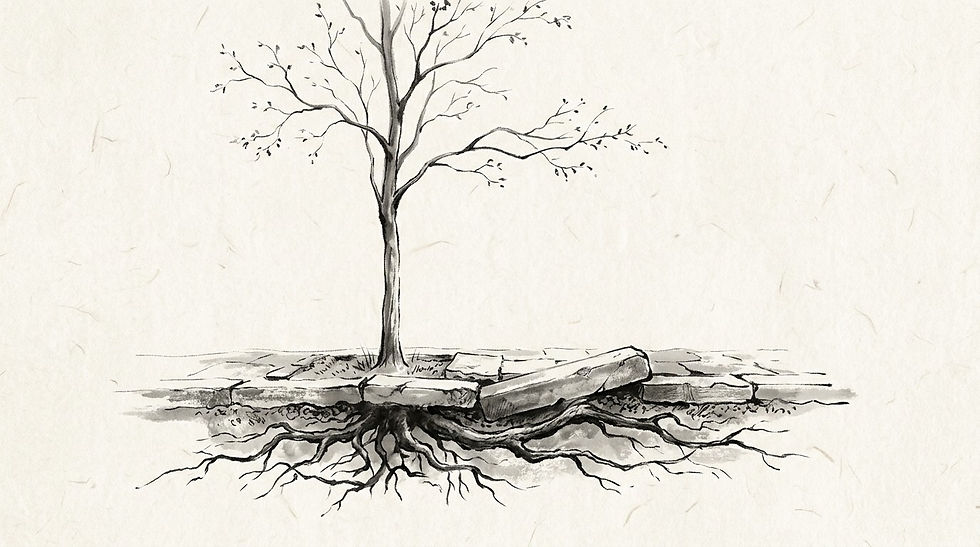
The tree is not too strong. The space is too small
The survey also showed when the damage became likely. When the trunk stood less than 35 centimetres from the kerb, more than half of the trees had lifted it. When the width of the pavement was 16 times the trunk diameter or less, the rate also passed 50 percent.
So the pavement is not lifted because the sweetgum is a bad tree. It is lifted because its roots were given a box of 1.5 by 1.5 metres. When we stand under a tree and look up, we imagine the roots are as wide as the branches. In this case they reached much further.
The same thing happens in gardens. If a tree that grows large is planted in a narrow space, the roots will always go outside it. When we advise on a sweetgum in a Japanese garden, the height of 20 metres is only half of the reason it is difficult. The other half is under the ground.


