A Mast Year for Persimmons — Ripening Fruit and the Birds That Depend on Winter Berries

2025 was a fruit year. The persimmon trees in our area produced more heavily than we have seen in several years — the branches bowed with the weight of the fruit through October and November, and by December, what the harvest had left was ripening to the softness that birds can access.
What Is a Mast Year?
'Mast' originally referred to the accumulated fallen nuts and fruit on a forest floor — the food resource that sustained pigs and other animals through winter in historical European forest management. A mast year is one in which trees produce an unusually large seed or fruit crop.
The mechanism is not fully understood. One leading hypothesis is the predator satiation model: by producing enormous quantities of fruit synchronously across many individuals, trees overwhelm the capacity of seed predators to consume all of them. Some proportion survives to germinate. Years of low production follow to reduce the populations of seed predators before the next mast event.
For trees that produce edible fruit — like persimmon — a mast year creates an exceptional resource for wildlife.
Birds and Persimmon
Persimmons that remain on the tree after harvest are used by several winter bird species in Japan. Brown-eared bulbuls (hiyodori) are among the most prominent — large, noisy, and persistent visitors to fruiting trees. Japanese white-eyes (mejiro) work the softer persimmons in groups, extracting the flesh through the skin. Thrushes — including dusky thrushes (tsugumi) arriving from the north — take the fallen fruit.
In a heavy fruit year, this resource extends the period during which birds can find high-calorie food without extensive foraging. The relationship between fruit-bearing trees and overwintering birds is direct: the trees that produce fruit consistently, and especially in heavy years, attract and sustain a wider diversity of bird species through the difficult months.
Managing Persimmons for Wildlife
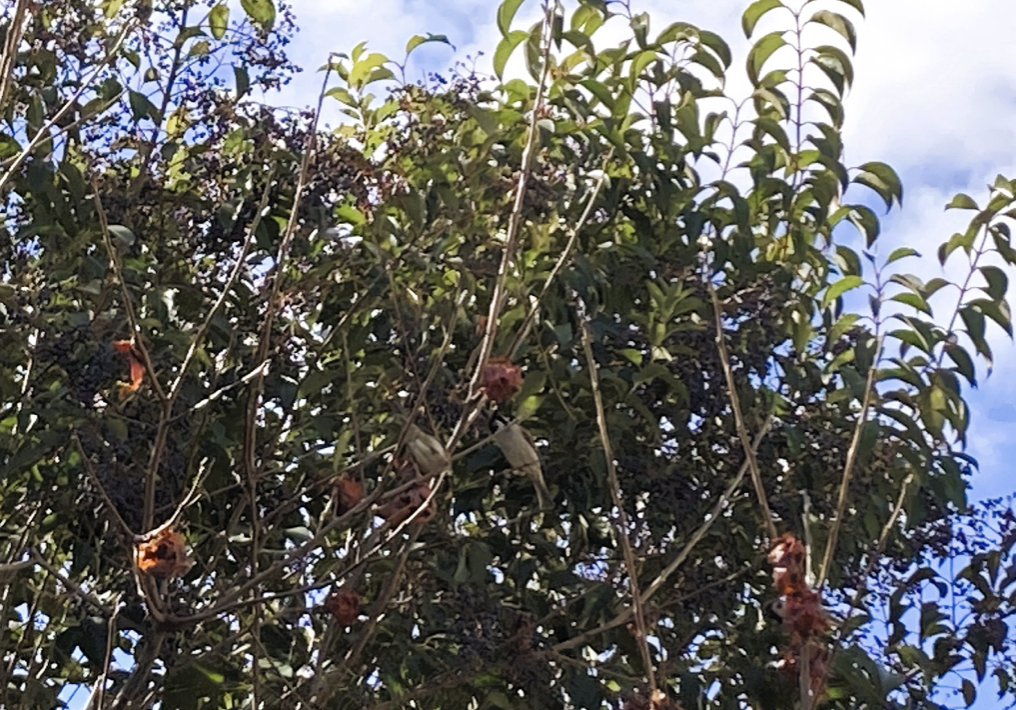
A practical point for gardens with persimmon trees: leaving some fruit on the tree after the human harvest is complete provides a resource for birds through winter. This does not require any additional action — simply harvesting what you need and leaving the rest. The remaining fruit softens on the branch through November and December and becomes accessible to species that cannot pierce firm skin.
Frequently Asked Questions
Q: Do all persimmon varieties attract birds equally?
A: Astringent varieties (shibugaki) that are not edible without processing tend to remain on the tree longer than sweet varieties (amagaki), simply because they are not harvested as completely. This makes them more available to birds through winter. Sweet varieties, if harvested thoroughly, leave less for wildlife.
Q: What other fruit trees support birds in Japanese gardens through winter?
A: Berry-producing trees and shrubs are particularly valuable: nandina (nanten), pyracantha, holly (hiiragi), and mountain ash (nanakamado) provide small fruits accessible to birds through winter. Larger fruit trees — crabapple, Japanese raisin tree — are used by larger species.
Q: Is a mast year predictable?
A: Not reliably. The triggers appear to include weather conditions in the previous growing season — temperature and rainfall during flower formation and fruit development — but the exact mechanisms vary by species and are influenced by multiple interacting factors. Experienced observers of particular trees can sometimes notice signs of heavy budding before the fruit develops, but formal prediction is difficult.