Borage: The Madonna Blue Herb That Has Grown in Gardens Since Ancient Rome

Updated: May 4
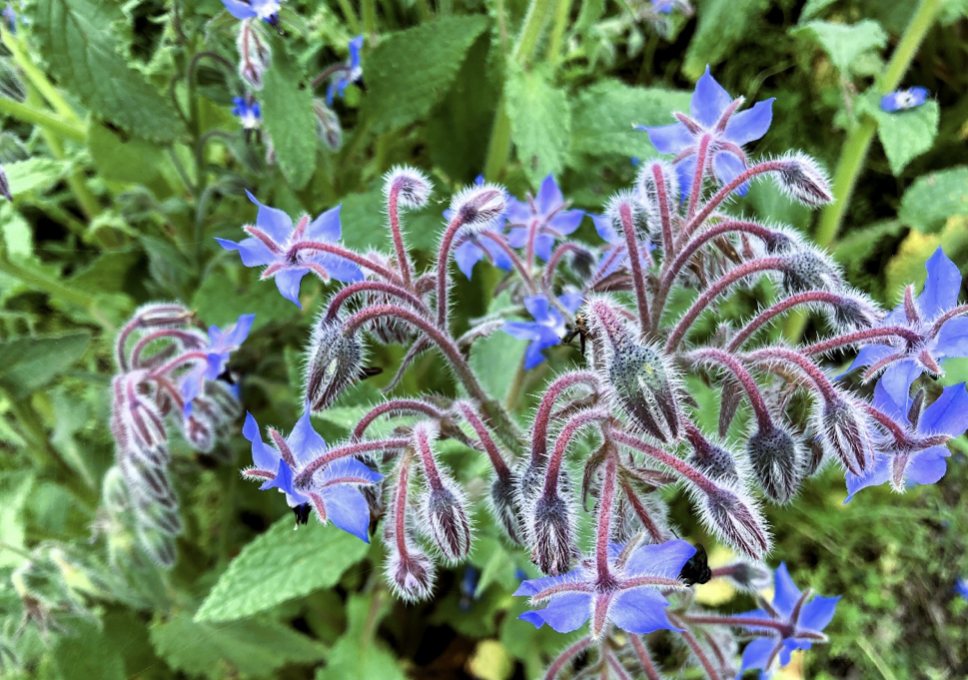
There is a blue that painters argue about. Not the blue of the sky, which changes. Not the blue of the sea, which varies by depth and weather. The blue of borage flowers — a clear, transparent, slightly violet-leaning blue — was distinctive enough that Renaissance painters used it as a reference when mixing the color for the Virgin Mary's robe.
The name Madonna Blue, as applied to this particular shade, traces back to this practice.
A Plant With a Long History
Borage (Borago officinalis) has been cultivated around the Mediterranean since at least ancient Roman times. Roman soldiers reportedly carried it to improve morale — the Latin phrase ego borago gaudia semper ago (I, borage, always bring courage) appears in early herbal records. Medieval European herbalists prescribed it for melancholy and to strengthen the heart.
Modern research has identified gamma-linolenic acid (GLA) in borage seed oil — an anti-inflammatory fatty acid also found in evening primrose oil. The anti-rheumatic and anti-inflammatory properties attributed to borage in traditional medicine have some basis in its chemical composition, though borage is not currently a mainstream medicinal plant in Japan.
Growing Borage
Borage is a fast-growing annual that self-sows readily. Seeds can be sown directly in the garden in spring, in a sunny location with reasonable drainage. The plant grows 60 to 100 centimeters tall, with rough-textured leaves and hollow stems. Flowers appear from early summer and continue until the plant is cut back or frost arrives.
In Japanese gardens, borage is grown primarily as an ornamental herb. The star-shaped flowers droop slightly, nodding downward — a characteristic that makes them easy to miss from a distance but striking up close. The texture of the leaves — rough and slightly bristled — is distinctive to the touch.
Edible and Culinary Uses
The flowers are edible — their flavor is mild, slightly cucumber-like. They are used as garnishes in salads, frozen in ice cubes for summer drinks, and crystallized in sugar for confectionery decoration. The young leaves can be used similarly to cucumber in cold preparations.
In European cooking, borage leaves were historically cooked like spinach or added to summer drinks — particularly the British drink Pimm's, where borage is a traditional garnish.
Frequently Asked Questions
Q: Does borage attract pollinators?
A: Yes — borage is one of the better-known bee-attracting plants. The flowers produce accessible nectar and are heavily visited by bumblebees and honeybees. In vegetable gardens, planting borage nearby is a traditional companion planting practice to improve pollination.
Q: Is borage invasive?
A: It self-sows freely, which can lead to it spreading widely in a garden if spent flower heads are not removed before seeds drop. It is not listed as invasive in Japan, but in small gardens it benefits from being managed so that seedlings appear only where wanted.
Q: Can borage be grown in containers?
A: Yes, though it grows large and prefers a container of at least 30 centimeters in diameter. Container growing limits its tendency to self-sow and makes it easier to place the plant where the flowers can be seen at close range.