Life Returns to Bamboo Soil: What We Found Inside a Brushwood Terrace

We dug gently into the fallen leaves packed behind the brushwood terrace, and the soil was moving.
Woodlice. Earthworms. Small white springtails.
Then we dug into the bamboo grove itself, two metres away, on the same slope. Almost nothing.
That contrast is the whole story of this work.
The site is a private temple woodland in Kameyama City, Mie Prefecture, Japan. It is a stand of madake bamboo slowly giving way to broadleaf forest. The slope had been losing its topsoil, so we built shigara: a low retaining terrace of bamboo stakes and horizontal poles, laid along the contour line, packed behind with konara oak leaves.
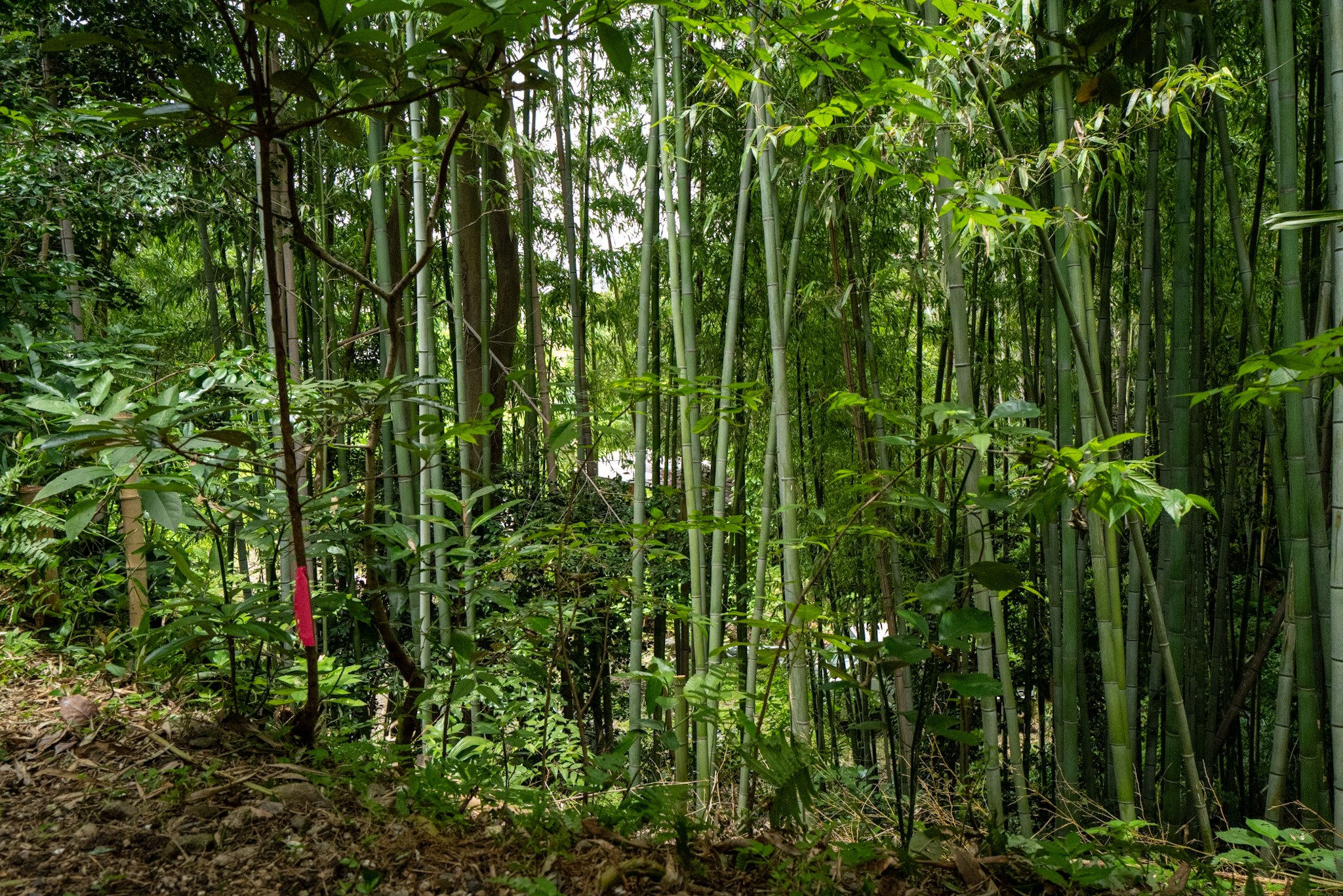
The technique is old. What is new is knowing why it works.
Bamboo soil is quiet soil, and there are four reasons for that.
First, bamboo litter resists decomposition. Bamboo takes up silica and cycles it through its body, and its leaves and culms also hold lignin. For soil animals, that is hard food of low quality. (Chiba University repository https://opac.ll.chiba-u.jp/da/curator/101795/D20150928_HMB_0028.pdf )
Second, the carbon to nitrogen ratio of bamboo litter is high. Decomposition runs slow, and the microbes attempting it draw nitrogen out of the soil rather than releasing it. (https://minorasu.basf.co.jp/80146 )
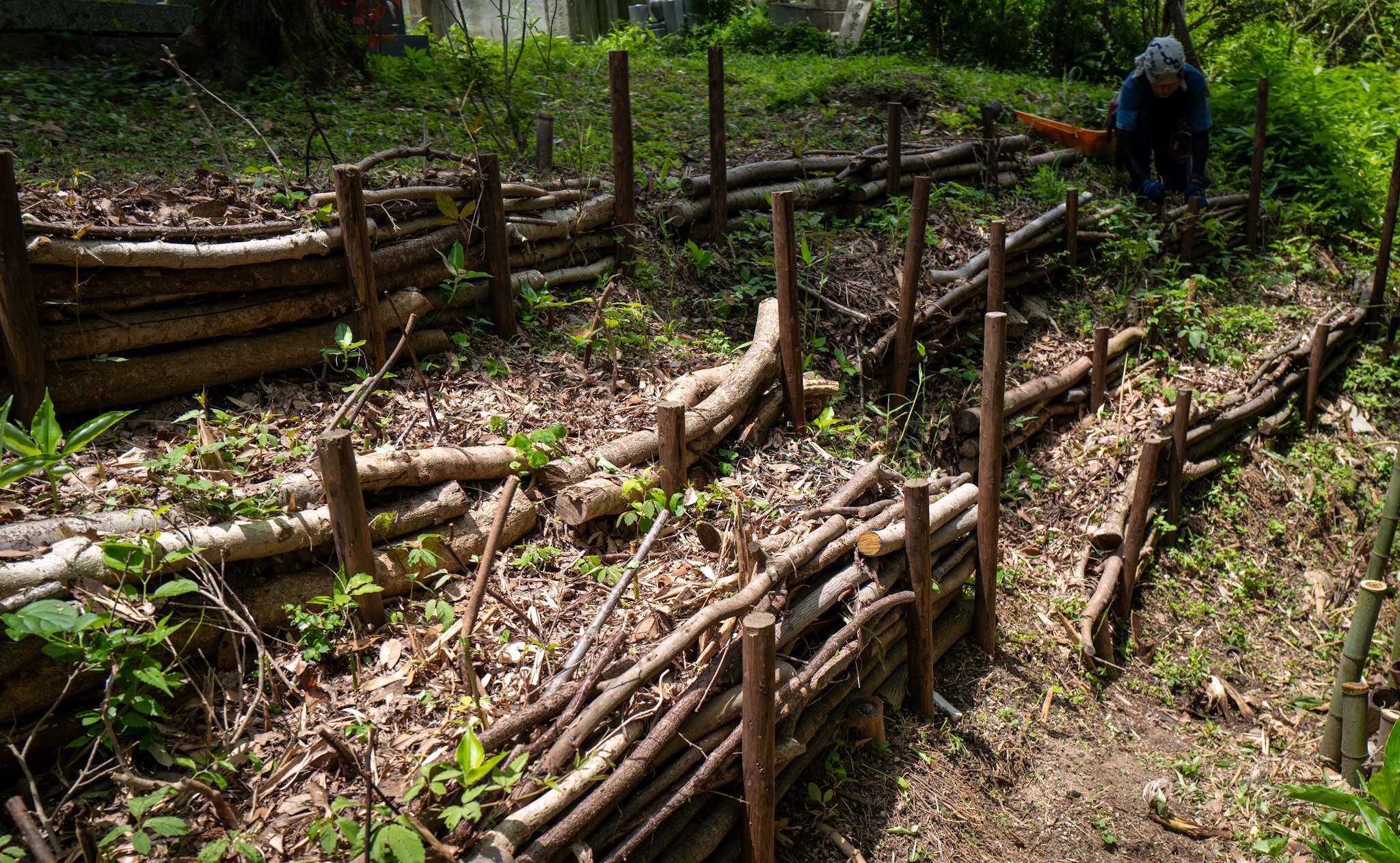
Third, densely standing culms and a thick litter layer block the light. The forest floor goes dark and dry. (Kyoto University of Education https://www.kyokyo-u.ac.jp/cee/15-8.pdf )
Fourth, and this is the one most people miss, the underground community shifts. Madake rhizomes and arbuscular mycorrhizal fungi dominate. The ectomycorrhizal fungi that partner with broadleaf trees become scarce.
So litter accumulates, and still the soil stays quiet.
I should say plainly that not every study agrees bamboo groves are low in diversity. This is what we observed on this slope, in this stand, with our own hands.
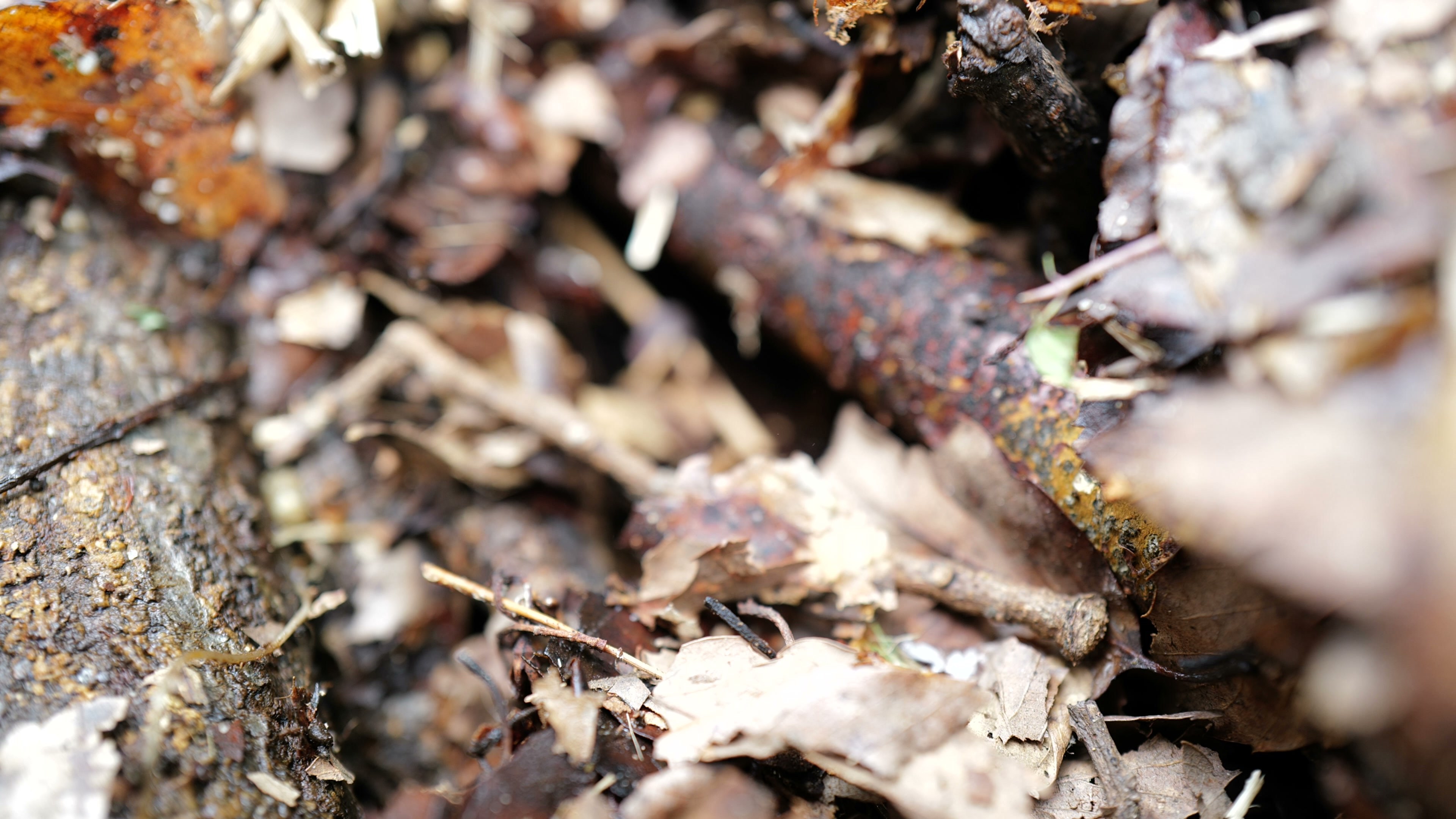
Into that quiet soil, we placed konara oak leaves behind bamboo stakes.
Oak litter is different. Its carbon to nitrogen ratio is moderate, and the leaves are soft and break down readily. The stakes, the poles and the packed leaves together hold moisture, keep the space shaded, and let organic matter gather. For a soil animal, food and shelter arrive in the same place.
That is why the shigara became an island of life inside soil that had almost none.
Inside, the animals were dividing the work between them.
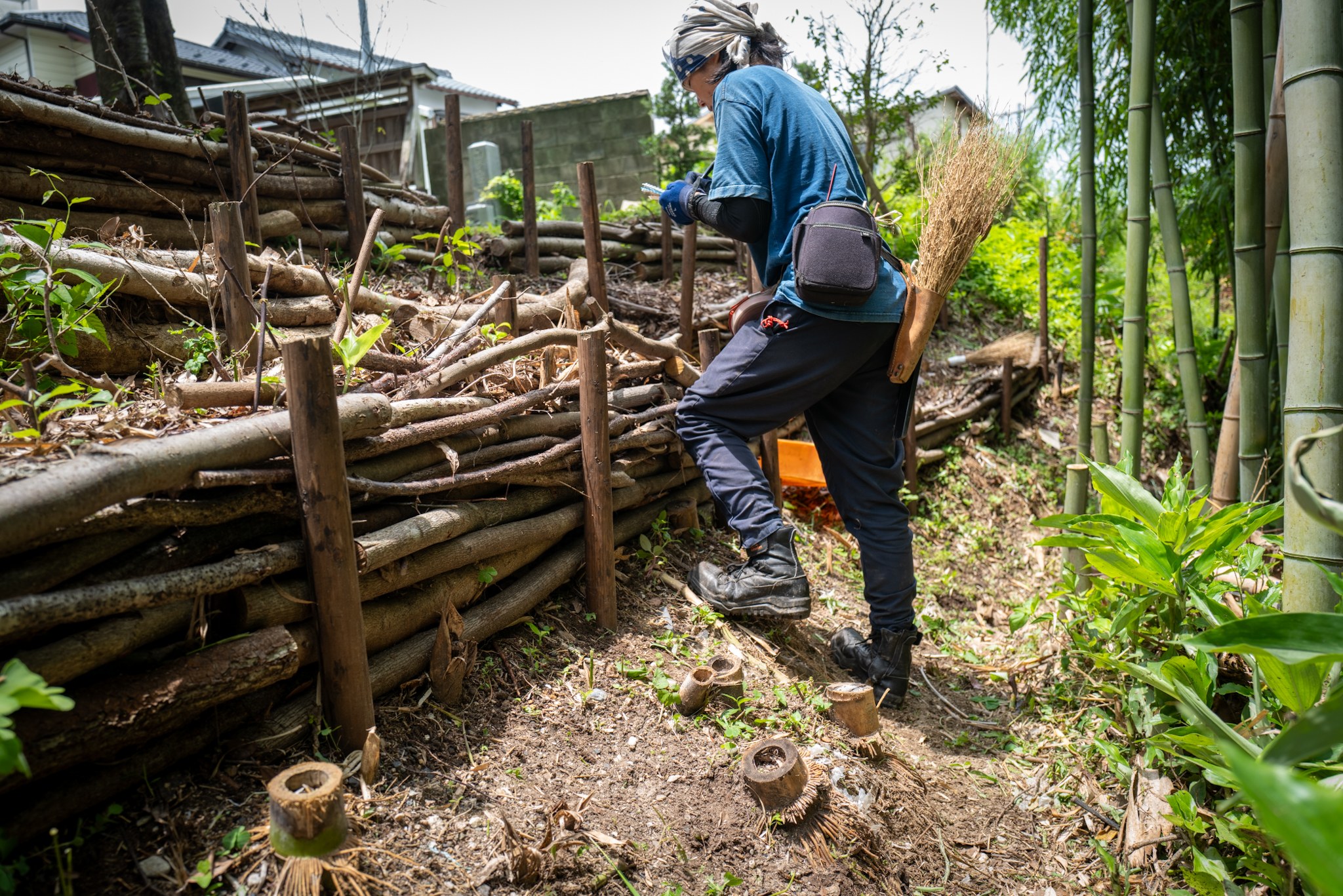
Woodlice and sowbugs are crustaceans, relatives of shrimp and crab. They chew fallen leaves into fragments, and the fragments gain surface area for fungi and bacteria to colonise. They are the preparation crew.
The small white springtails graze the fungi and keep the fungal balance in order. Recent research indicates that many springtails feed less on the litter itself than on mycorrhizal fungi and newly fixed carbon. (Forestry and Forest Products Research Institute and others, 2021 https://www.ffpri.affrc.go.jp/press/2021/20211108/index.html )
Then the earthworms. They eat leaves and pass castings, and those castings become water stable aggregates that let soil breathe, hold water and drain at the same time. (Miwa Arai, NARO https://www.jstage.jst.go.jp/article/dojo/88/5/88_880511/_pdf/-char/ja )
Earthworms are the engineers. They assemble the soil itself.
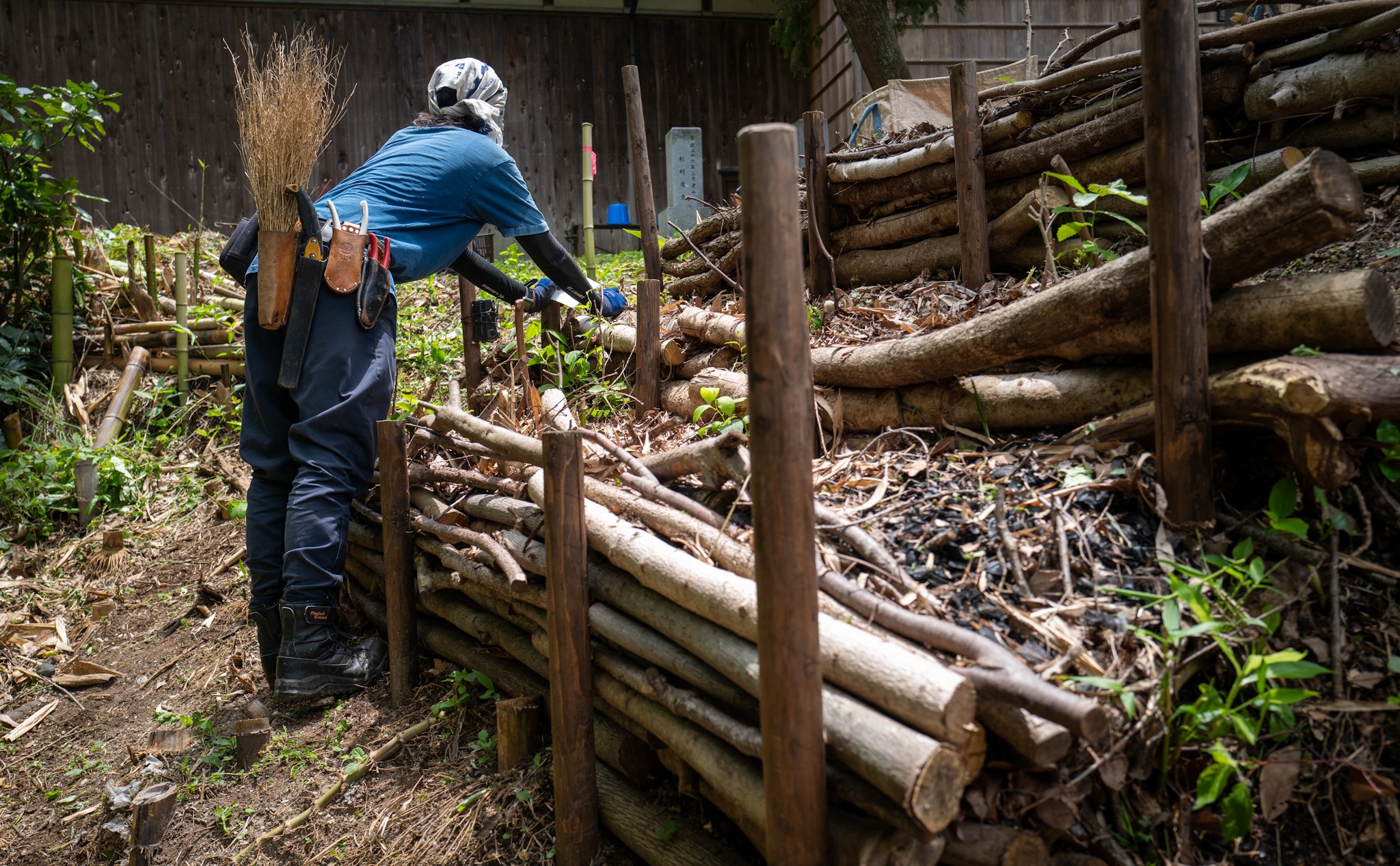
One crew breaks it down, one keeps the fungi in balance, one builds the structure. Through that relay, bamboo and oak return to soil.
The oak seedlings we confirmed on this slope earlier are rooting in soil these animals made.
There is a principle in this work that sounds like failure and is not.
Disappearing is success.
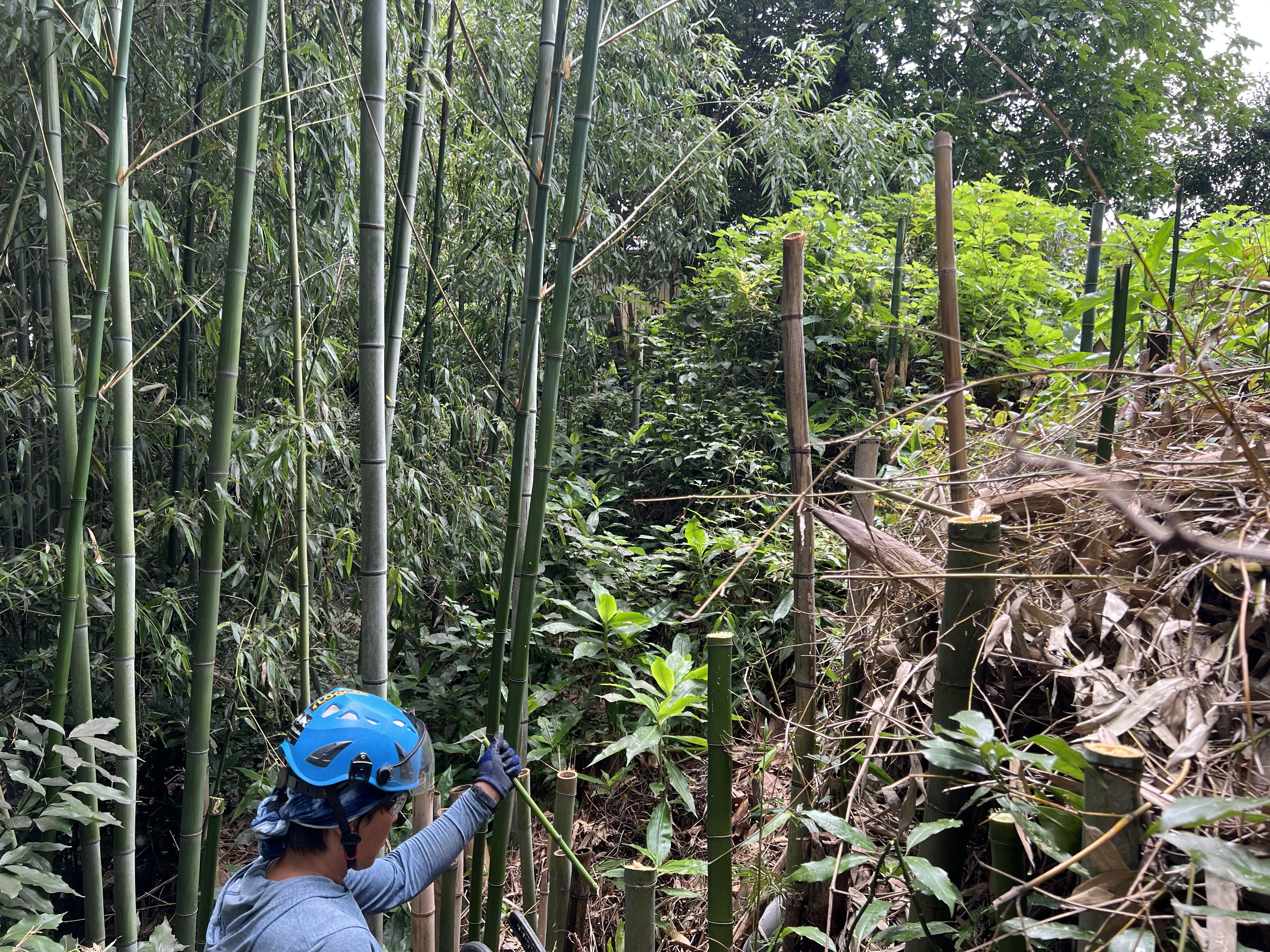
Cutting a tree, building a terrace, our hands are only the starting point for a return to nature. What we assemble will decay in ten or twenty years. But before it does, these small workers convert the material into soil, and hand that soil to the oak seedlings just beginning.
Bamboo management is not the work of reducing bamboo.
It is the work of returning life to soil that had lost it. Out of sight, underground, the next forest has already started.