Monstera as a Natural Humidifier — Japan's Winter Relationship With Indoor Plants

February in Japan brings two things together: cold air from the continent and indoor heating that runs continuously. The combination dries the air inside homes to the point where throat and nasal passages feel it — the slight rawness that comes before winter illness, the skin that asks for more moisture.
Mechanical humidifiers are common in Japanese homes. They work. But they require maintenance — regular cleaning to prevent mold growth in the water reservoir, electricity to run, and a degree of attention that a busy household may not always give them.
Large-leaved tropical plants offer something different. Not a replacement for a humidifier in cases of significant dryness, but a continuous, low-maintenance contribution to indoor humidity that costs nothing to run once the plant is established.
How Plants Release Water
Plants lose water continuously through small pores in their leaves called stomata. This process — transpiration — is how plants regulate temperature and transport nutrients from roots to leaves. For the plant, it is a physiological necessity. For the room the plant inhabits, it means a constant, gentle release of water vapor.
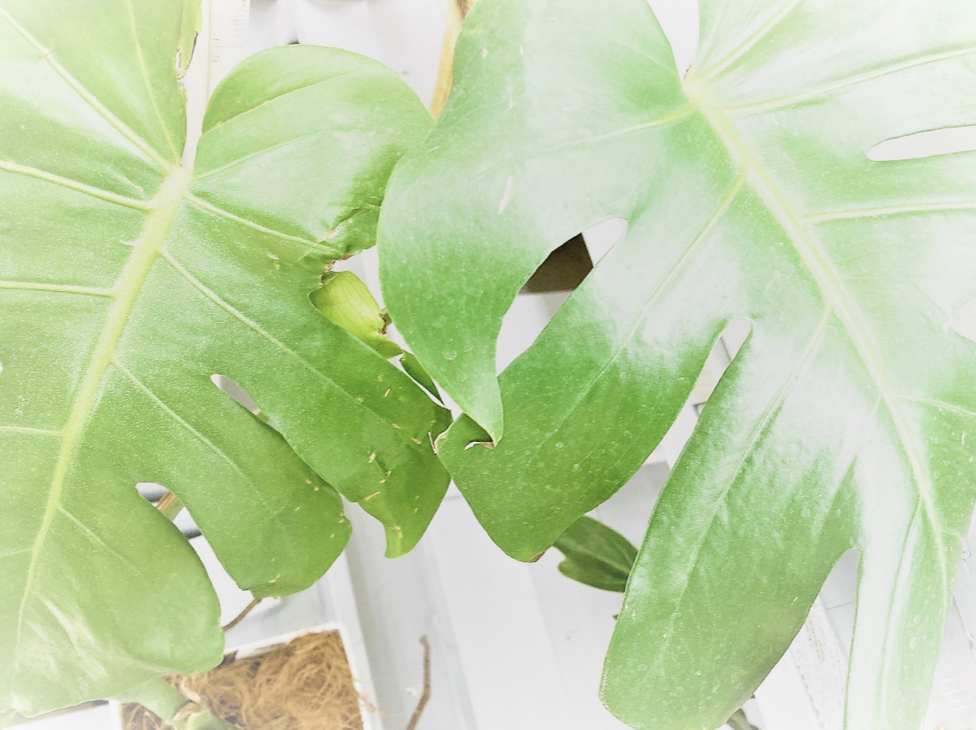
Monstera deliciosa, with its large, fenestrated leaves and tropical origins, transpires actively. A mature plant in a warm, bright room can release measurable amounts of moisture each day. NASA's well-known clean air study also identified monstera relatives in the list of plants that remove volatile organic compounds from indoor air — formaldehyde, benzene, and similar compounds off-gassed from furniture and building materials.
The practical effect is modest but real. In a sealed room with several large plants, humidity levels rise perceptibly compared to a plant-free equivalent. The air also feels different — not wetter in a clammy way, but softer.
Caring for Monstera in Japan's Climate
Monstera is well-suited to Japanese homes. It prefers indirect light — the bright but shaded conditions of a room with a north or east-facing window work well. Direct summer sun will bleach and burn the leaves; indirect light allows them to develop fully.
In winter, reduce watering significantly. The plant's growth slows, and roots sitting in wet soil in cool conditions are vulnerable to rot. Allow the top few centimeters of soil to dry completely before watering. Misting the leaves occasionally helps maintain the humid conditions monstera prefers and keeps the large leaf surfaces clean — dust reduces transpiration efficiency.
Temperature is the main limiting factor in Japan. Monstera prefers above 10°C at minimum. In homes that are well-heated in winter, this is rarely an issue. Avoid placement near windows in cold regions where glass temperatures drop significantly at night.
Frequently Asked Questions
Q: How many plants do you need to noticeably humidify a room?
This depends on room size and how dry the air is. For a standard Japanese room of 10-15 square meters, three to five large plants can contribute meaningfully to humidity levels. A single large monstera will help, but for significant effect, multiple plants or a combination of high-transpiration species works better.
Q: What other plants are good natural humidifiers?
Peace lily (Spathiphyllum), Boston fern (Nephrolepis exaltata), rubber plant (Ficus elastica), and areca palm (Dypsis lutescens) all transpire actively and are well-suited to indoor conditions in Japan. Ferns require particularly high humidity themselves, which creates a feedback loop — they add moisture and prefer moisture.
Q: Can monstera grow in a Japanese winter with limited sunlight?
Yes, with some adaptation. Monstera tolerates lower light levels than most tropical plants. In Japan's winter, shorter days reduce light but the plant survives and maintains its leaves. Growth slows dramatically, which is normal. Place near the brightest available window and avoid rooms that receive no natural light.
The plants in a Japanese home in winter are not decorations. They are working. This is perhaps the most Japanese thing about them — the quiet contribution, the function that arrives without announcement.