Muscari: The Tiny Grape-Flower That Blooms Every Spring Without Replanting

Updated: May 4
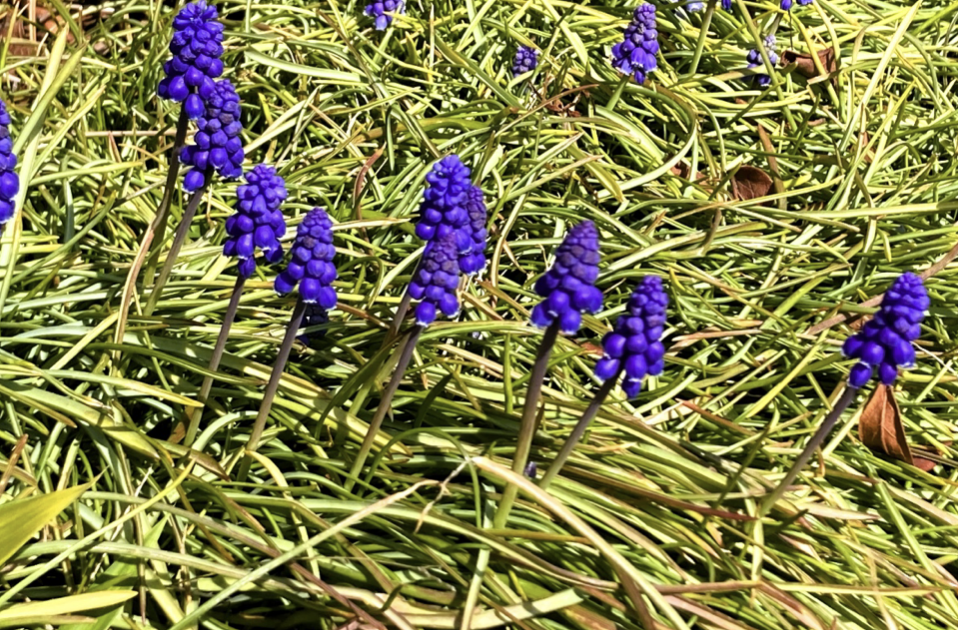
In early spring, before most other bulbs have committed to flowering, muscari appears. The clusters of small, grape-like flowers — densely packed along a short stem — arrive in blue-purple, sometimes white or pale yellow, and stay for several weeks.
What Is Muscari?
Muscari belongs to the Asparagaceae family and originates from the Mediterranean region and western Asia. In English it is commonly called grape hyacinth, for the resemblance of its flower clusters to small bunches of grapes. In Japan it is grown primarily as a spring-flowering ornamental bulb.
The plant grows 15 to 20 centimeters tall, with narrow, strap-like leaves that emerge in autumn and remain through winter. The flower spikes appear in March through May, depending on the region and variety.
Plant Once, Enjoy for Years
One of muscari's most practical qualities is its persistence. Unlike some bulbs that fade after a year or two, muscari naturalizes — meaning it multiplies slowly and returns stronger each spring without replanting. In the right conditions, a small initial planting can fill a border over several years.
Bulbs are planted in autumn, typically October in Japan. They are small — about the size of a large grape — and undemanding about soil, provided drainage is reasonable. They tolerate cold well and need no special winter protection in most of Japan.
After flowering, the leaves continue to grow for several more weeks, manufacturing the energy stored in the bulb for next year's bloom. Cutting the leaves back too early reduces flowering the following season; waiting until they yellow naturally is best practice.
Varieties and Colors
The most common garden muscari is Muscari armeniacum, in the familiar deep blue-purple. But the genus includes varieties in white (M. botryoides 'Album'), soft lavender, pale yellow, and even bicolor forms. Many garden centers in Japan carry several varieties, allowing for combinations that extend the visual range of the spring display.
Flower Meaning
In the Japanese language of flowers, muscari carries the meanings 'a bright future' and 'understanding between hearts' — associations that have made it a popular choice for spring gifts and garden arrangements.
Frequently Asked Questions
Q: Does muscari spread on its own?
A: Yes, gradually. Muscari naturalizes by producing offsets (daughter bulbs) and by seed. Over several years, an initial planting will expand. If you want to control the spread, divide clumps every three to four years in early summer after the leaves die down.
Q: Can muscari grow in containers?
A: Very well. Containers are a popular choice because they allow precise control of soil mix and drainage. Plant bulbs in autumn, keep the container in a cool location through winter, and move it to a sunny spot as spring approaches.
Q: Does muscari have a fragrance?
A: Some species, including Muscari armeniacum, have a mild, sweet scent — though it is subtle rather than pronounced. The name Muscari itself comes from the Greek for musk, referencing the scent of the original described species.