Pruning a Camphor Tree in Satoyama — Arborist Field Report, Mie, Japan

Updated: May 30
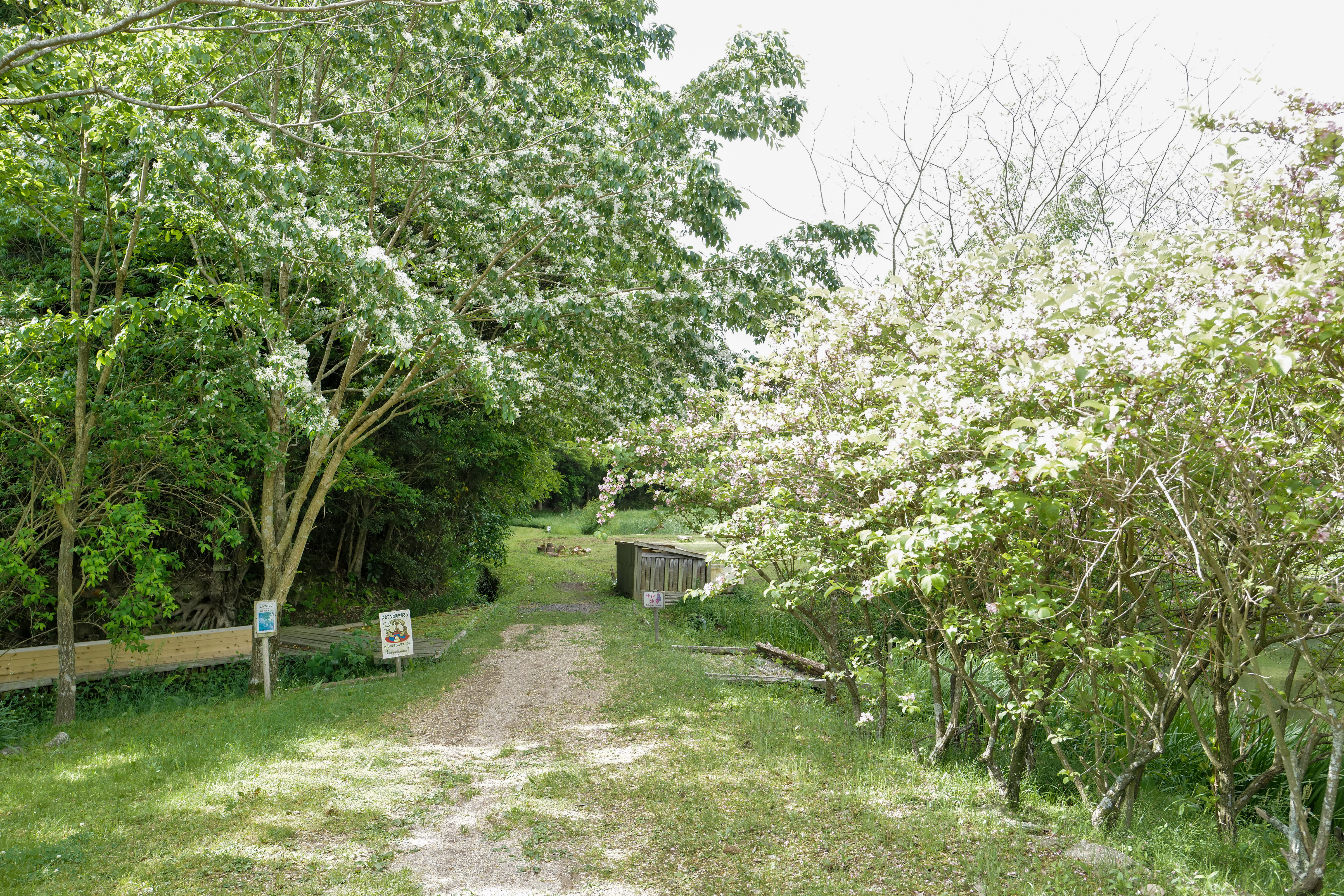
Looking up at the camphor tree, we could see the problem before we even started.
Wisteria vines — some as thick as a forearm — had coiled through the upper canopy, wrapping around branches and blocking the light from reaching inside the crown. The tree was not in danger. But it was working harder than it needed to.
This is the kind of thing you only see when you are standing at the base, looking up. And it is exactly the kind of thing that tells you where to begin.
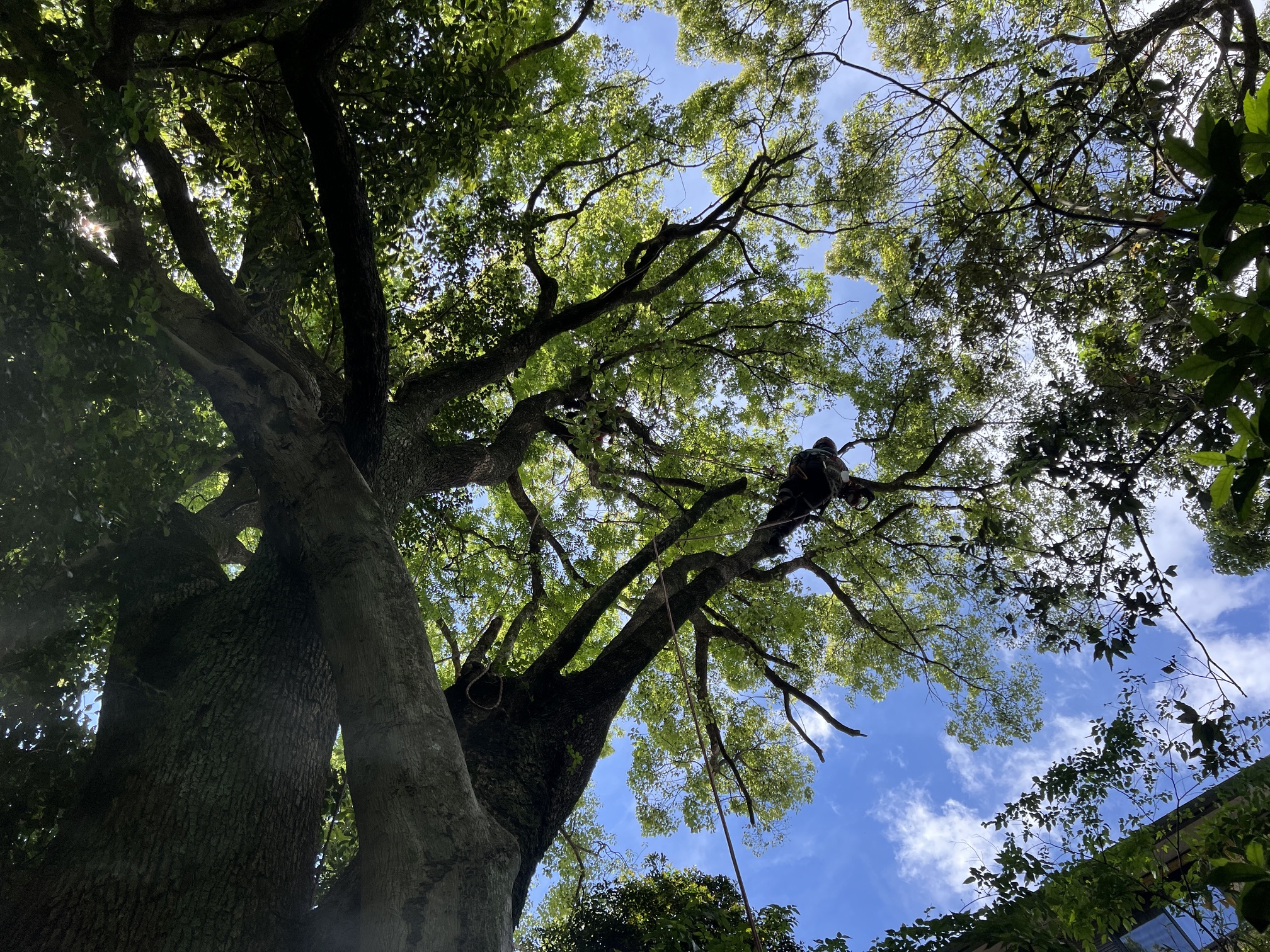
We were working at Kameyama Satoyama Park, a restored woodland in Kameyama City, Mie Prefecture, Japan — certified by Japan’s
Ministry of the Environment as an OECM site (Other Effective Area-based Conservation Measures). More than 10,000 people visit the park each year. The forest itself was once degraded farmland, brought back by community effort over decades.
We have been supporting the park’s tree management as part of a multi-year
conservation project — pro bono work toward an official certification application. This visit focused on the park’s camphor tree (Cinnamomum camphora), one of the largest and most visible trees along the trail.
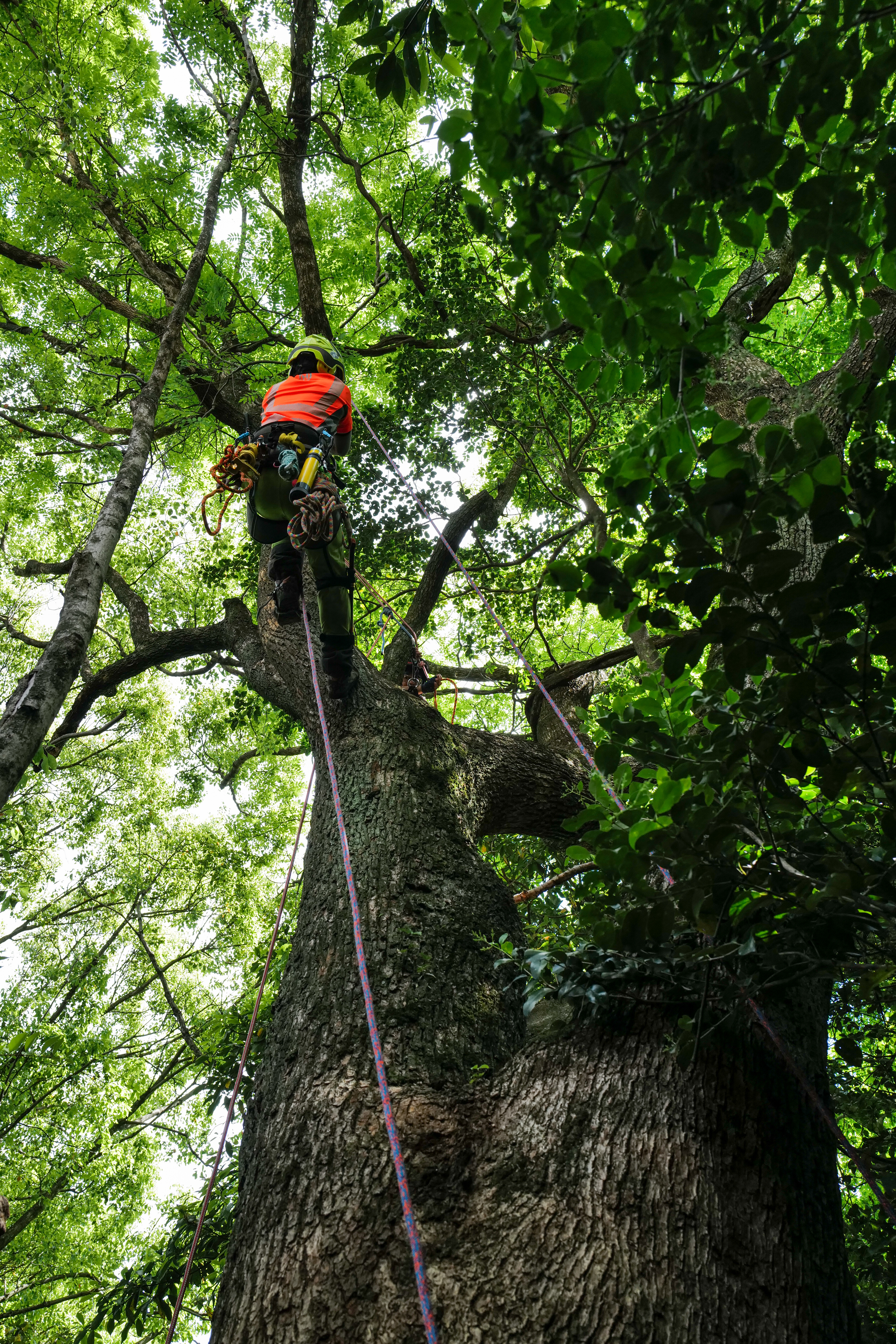
The work required two climbers.
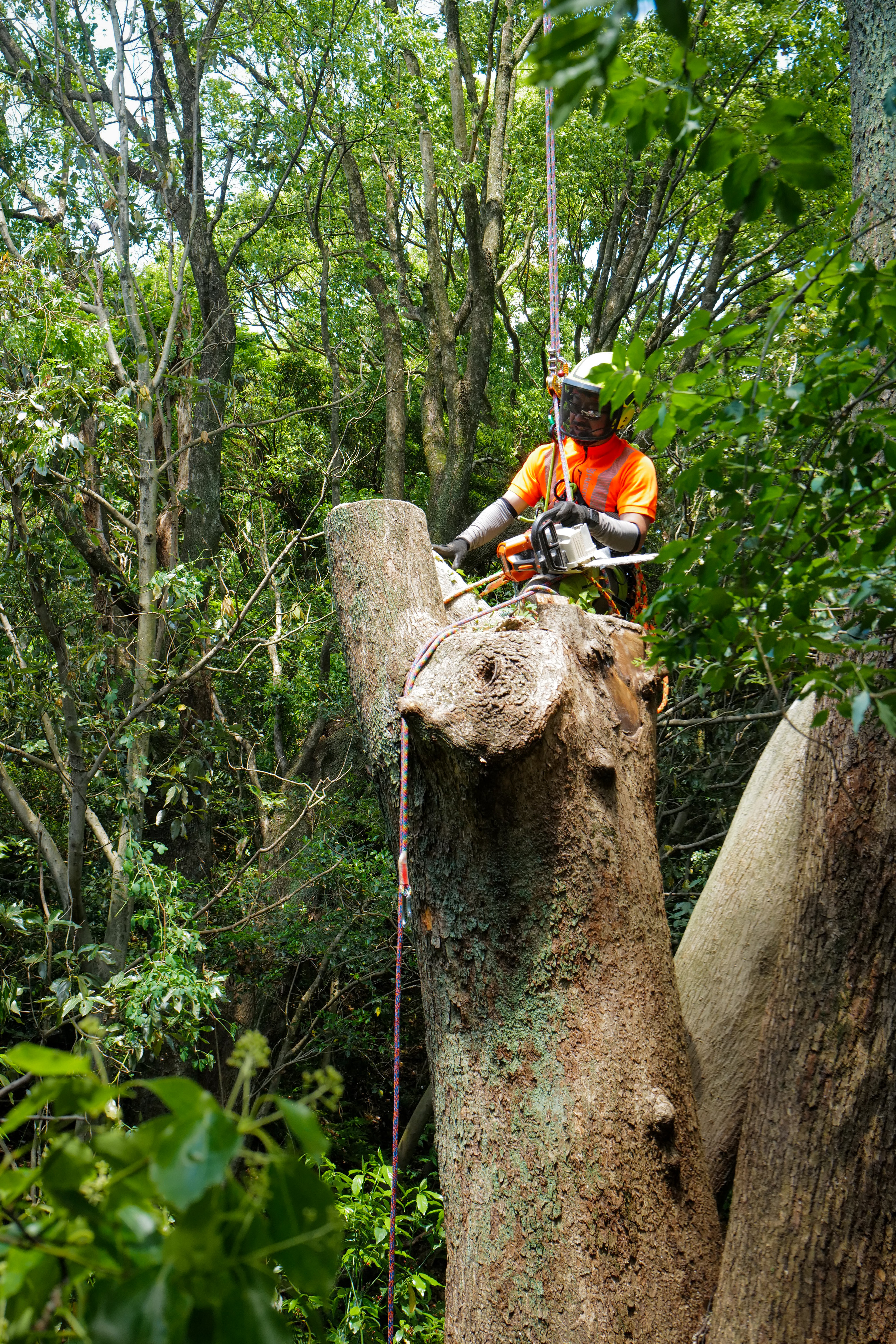
One of us went up with rope and harness — the first challenge was finding a good anchor point in a canopy laced with vines. From the ground, you see a tree’s silhouette. From inside it, you see the structure: which branches are competing, which are deadwood, which carry the load.
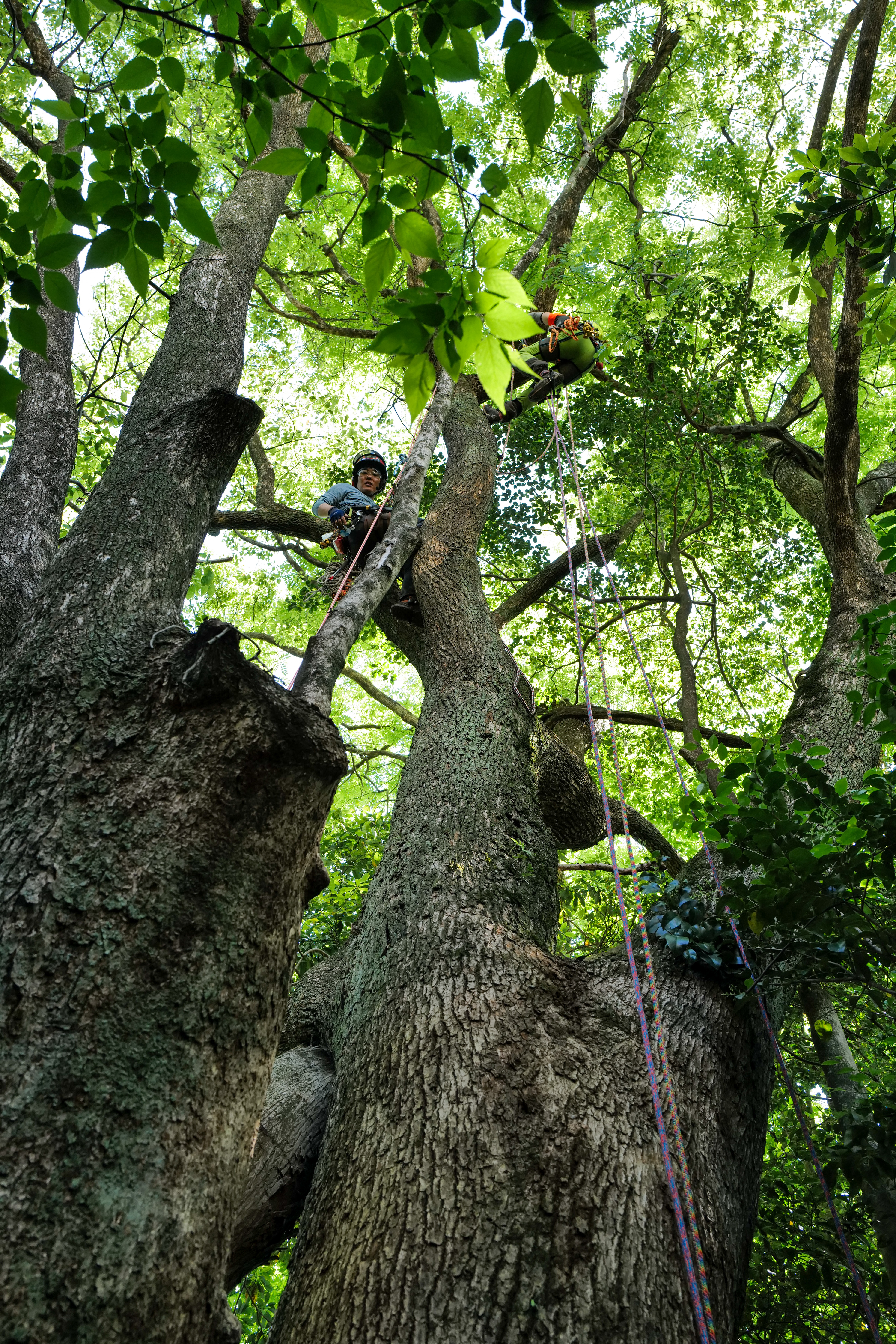
The goal was selective pruning — not removing branches, but choosing which ones to keep. A camphor tree has a shape it is trying to grow toward. You read that shape, and then you help it along. On the ground, the second climber handled the lower canopy and the wisteria roots.
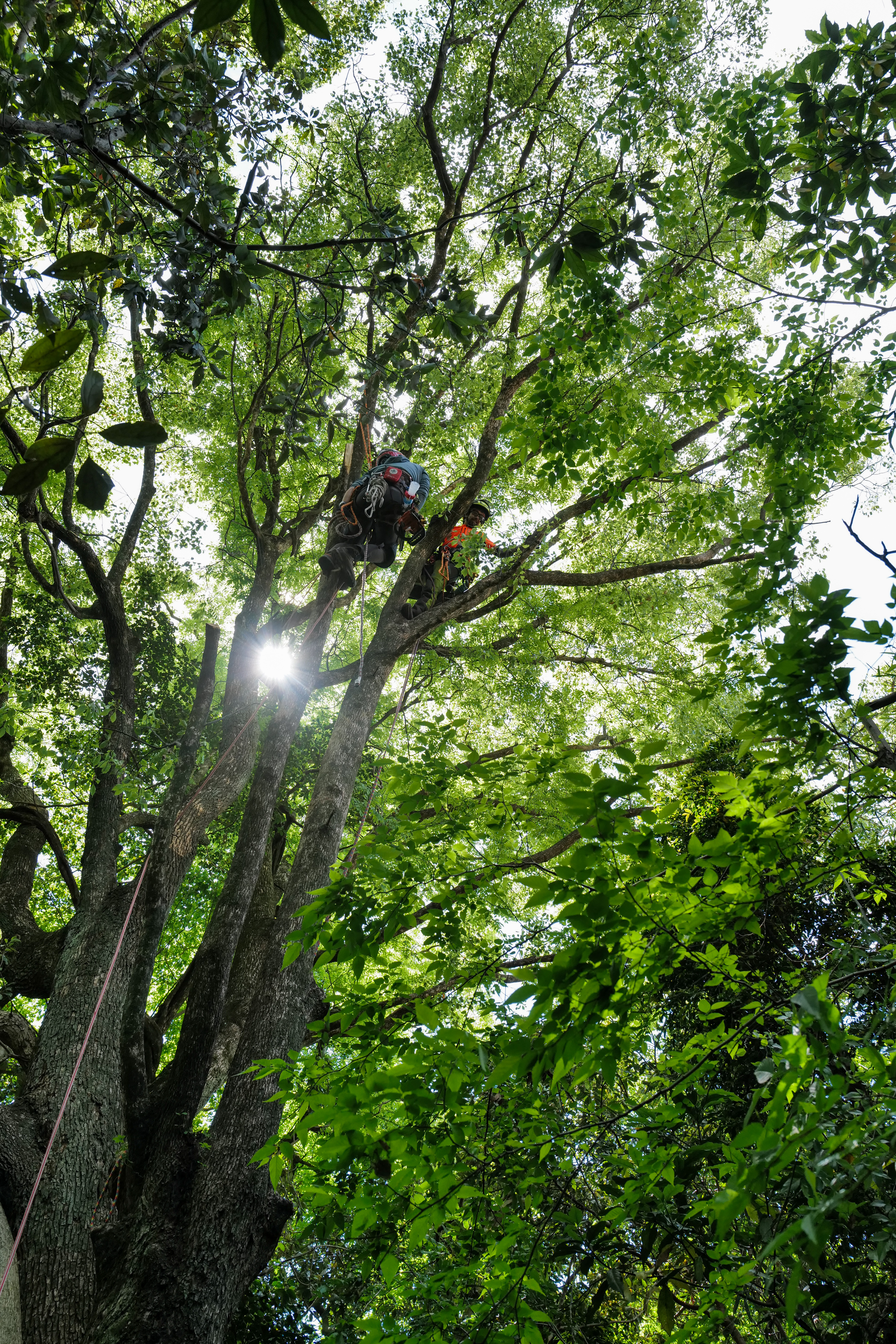
Working at height in backlight. Wind moves through the tree, and you move with it. What you see from up there is not what anyone below can see.
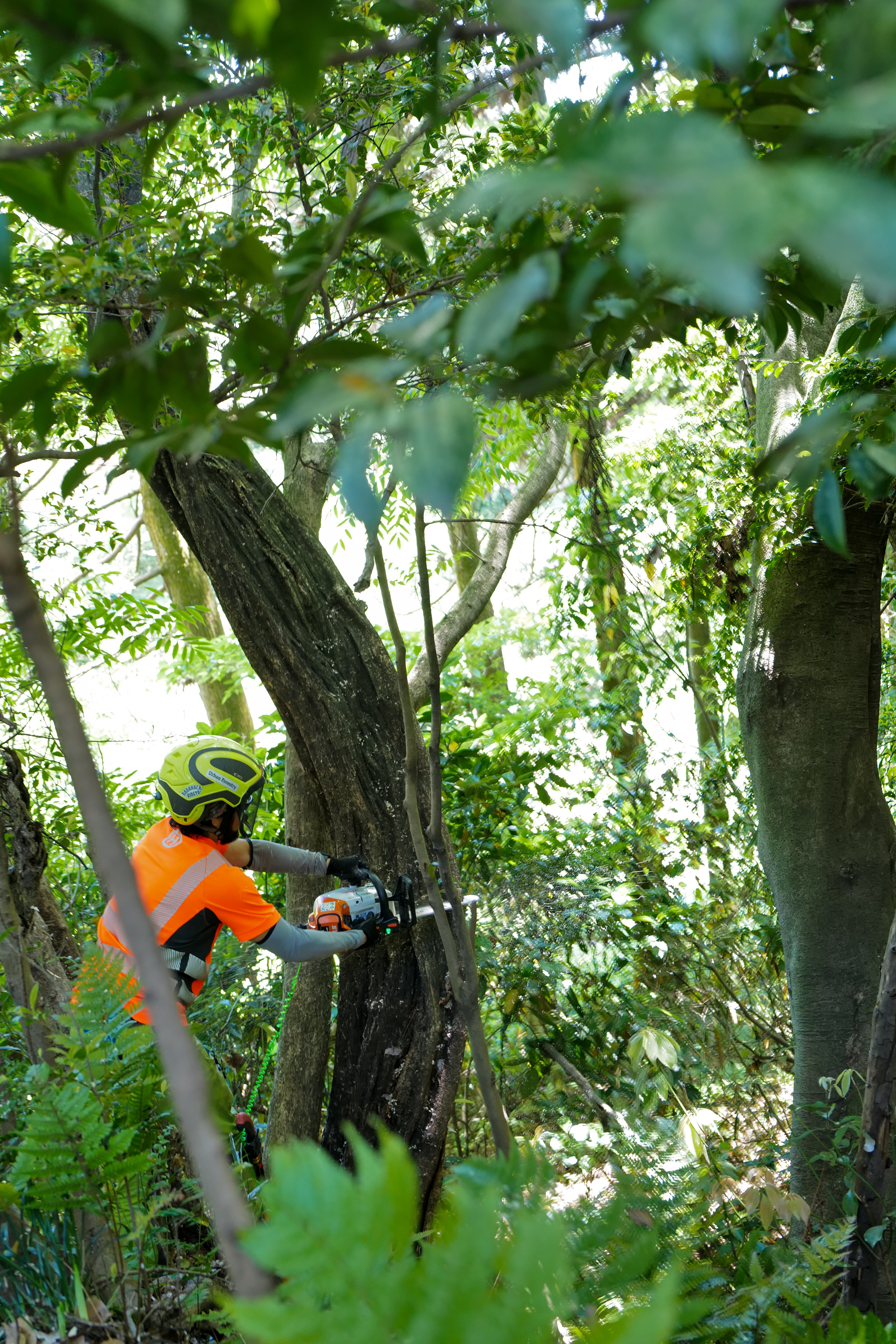
About wisteria vines: they are tenacious. The thickest ones were several centimeters in diameter, and their strength was a reminder of what years of unchecked growth can produce.
Wisteria is not a pest. It is a plant doing what plants do — climbing toward light. But it adds load to branches, reduces the light inside the crown, and in a typhoon can increase the risk of breakage.
We cut the vines at the base, which reduces the immediate load. For full removal, the roots need to be weakened over several seasons — or dug out entirely. Not eliminating. Managing the balance.
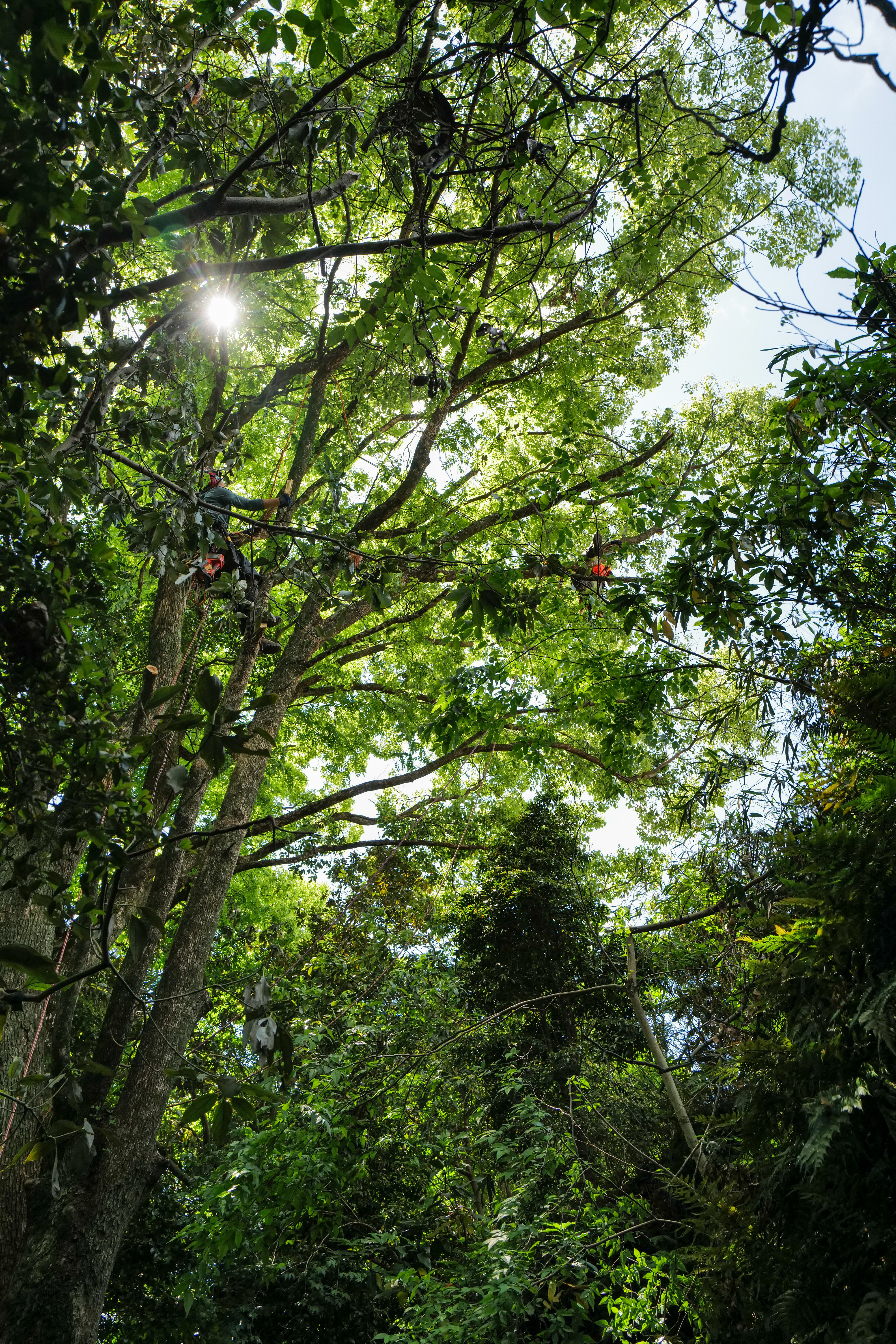
After the vines came down, the canopy opened up. Light reached the interior again.
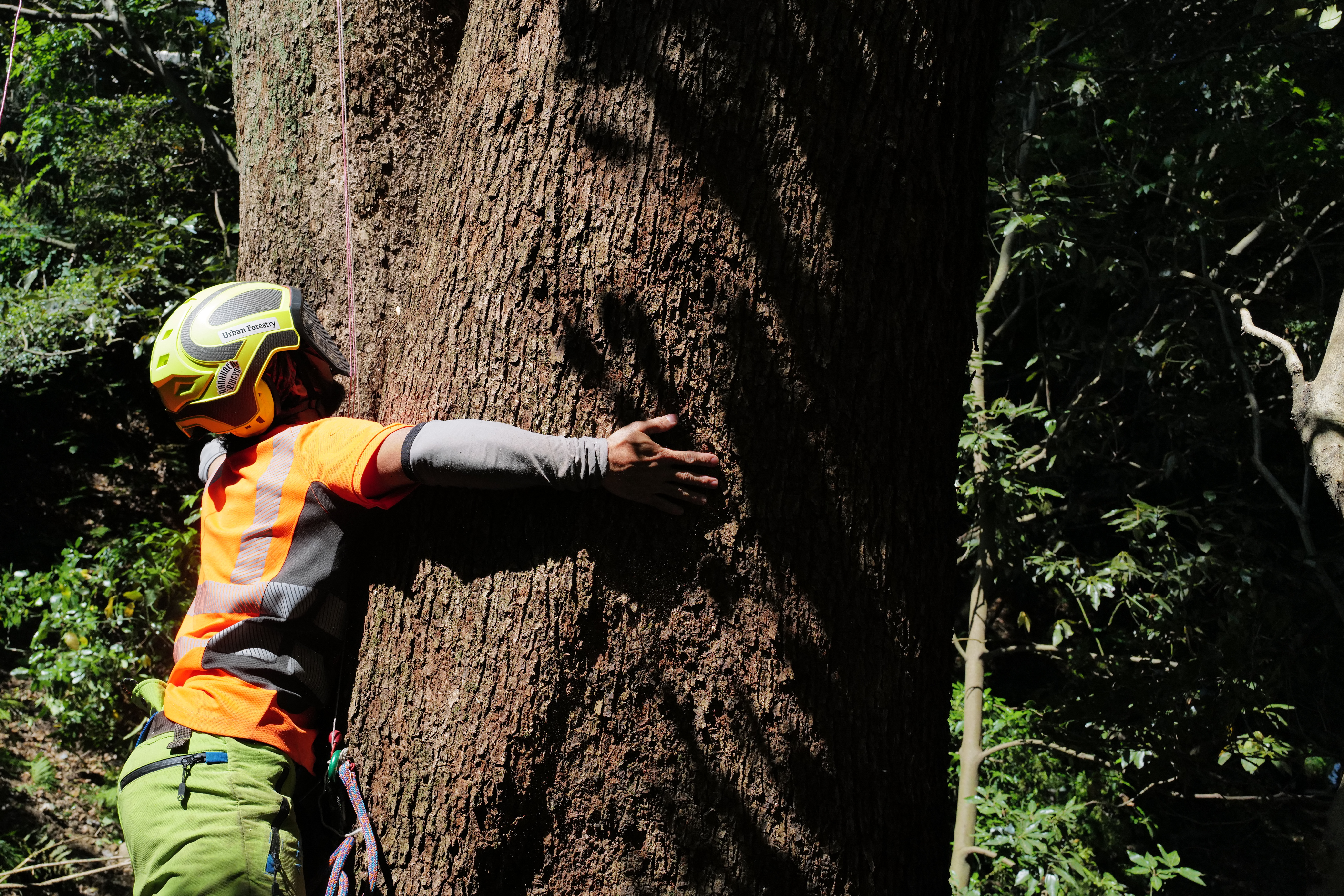
A note on camphor tree biology: camphor roots are shallow. Most of the major root structure sits within 30 to 50 centimeters of the surface, spreading horizontally to match — or exceed — the canopy’s footprint. That is why camphor trees are known for lifting pavement in urban settings. The soil around the base of the tree is directly connected to the tree’s vitality. Keep that soil healthy, and the tree stays healthy.
Before we finished, we installed a nest box on the upper trunk.
We have been placing nest boxes at several sites in Mie — for cavity-nesting birds like great tits and owls in forests where old hollow trees have been removed. The box we placed at
Kameyama is part of that ongoing work.
Whether it gets used, and by what species, is something we will find out when we return.
There is a phrase that stays with me from this kind of work:
Not removing. Listening.
We do not set out to take things away from a tree. We try to understand what it needs — more light, less load, room to grow — and then we remove exactly that, no more. A camphor tree in a satoyama park is not the same as one in a garden or a plantation. It lives in a complex place, shared with hikers, birds, insects, and other trees. The work has to account for all of that.
We will be back at Kameyama next year.
Whether the wisteria has regrown, whether the nest box has a tenant, whether the canopy has shifted — those are the questions we will be answering. That is how this kind of work goes: you set something in motion, and then you pay attention to what happens next.
Frequently Asked Questions
Q. What is the best time of year to prune a camphor tree?
A. Camphor trees are best pruned in early spring (March–April, before new growth) or early autumn (September–October). Avoid heavy pruning in midsummer — it places stress on the tree and can reduce vigor.
Q. Can wisteria vines really damage a mature tree?
A. A mature, healthy tree can tolerate some wisteria without serious harm. The issue is accumulation: over many years, vines add structural load, reduce interior light, and in high winds can increase the risk of branch failure. Cutting at the base is the first step; full removal takes multiple seasons.
Q. What is rope-assisted arborist climbing, and when is it used?
A. Rope climbing allows an arborist to work in the canopy without heavy machinery or scaffolding — essential in forest settings where access is limited. It is also gentler on the tree than working from a crane. We use it for high canopy pruning, deadwood removal, vine clearing, and nest box installation in places like this park.
Q. What is satoyama?
A. Satoyama is a Japanese term for the landscape between mountain forest and human settlement — farmland, woodland edges, and communities that have coexisted and shaped each other for centuries. Its biodiversity depends on ongoing management. Without it, bamboo spreads, light-canopy species disappear, and habitat diversity shrinks. Kameyama Satoyama Park is a restored example of that landscape.
Senteiya Sora is a certified tree care and landscaping company based in Komono-cho, Mie Prefecture, Japan.

Senteiya Sora is a Google News verified media source.