Sasanqua as a Fireproof Tree — Why Japanese Gardens Choose Beauty That Protects

In January, when most ornamental trees have lost their leaves and the garden has gone quiet, sasanqua continues to bloom. Small flowers, mostly white or soft pink, open in succession along branches that remain dense and green through winter.
What Is a Fireproof Tree?
In Japan, certain trees are classified as hiboju — fireproof trees. This is not a formal certification but a practical category used in landscape planning and municipal guidance. Trees earn this designation when they combine several characteristics: high moisture content in leaves and bark, slow combustion even when exposed to flame, and the ability to form a dense enough screen that fire moves more slowly through a garden or between structures.
Sasanqua fits this category well. Its leaves are thick and waxy, retaining moisture even in dry winter air. When exposed to fire, it chars rather than igniting quickly. Planted in a continuous hedge or line along a fence or property boundary, it can slow the spread of fire in ways that open ground or deciduous plants cannot.
Other commonly used fireproof trees in Japan include: Camellia japonica (tsubaki), the close relative of sasanqua; Pittosporum tobira (tobera); Elaeagnus pungens (natsugumi); and various species of holly (ilex). What they share is evergreen foliage with high water retention and relatively fire-resistant bark.
Why This Matters in Dense Neighborhoods
Japan's residential areas — particularly in older urban districts and in towns like those in Mie Prefecture where traditional wooden architecture is still common — face ongoing fire risk. The combination of wood-frame construction, narrow streets, and occasional strong winds creates conditions where a single fire can spread quickly.
Planting fireproof trees along fence lines and property boundaries is a traditional response to this risk. It is not infrastructure in the way that firebreaks in a forest are — it will not stop a major fire. But it adds resistance, slows spread, and gives residents and firefighters time.
The Relationship Between Beauty and Protection
What is interesting about sasanqua and other fireproof trees is that they were not chosen for their fire resistance alone. They were chosen because they are beautiful, practical in the garden, and historically available. The fire resistance is a secondary property that made an already-valued plant more valued still.
This is how much traditional Japanese garden design works. A plant earns its place through multiple overlapping functions: seasonal bloom, year-round structure, wildlife value, soil stability, and — in the right context — protection. Single-function planting is a more modern approach. The older tradition was to find plants that worked in many ways at once.
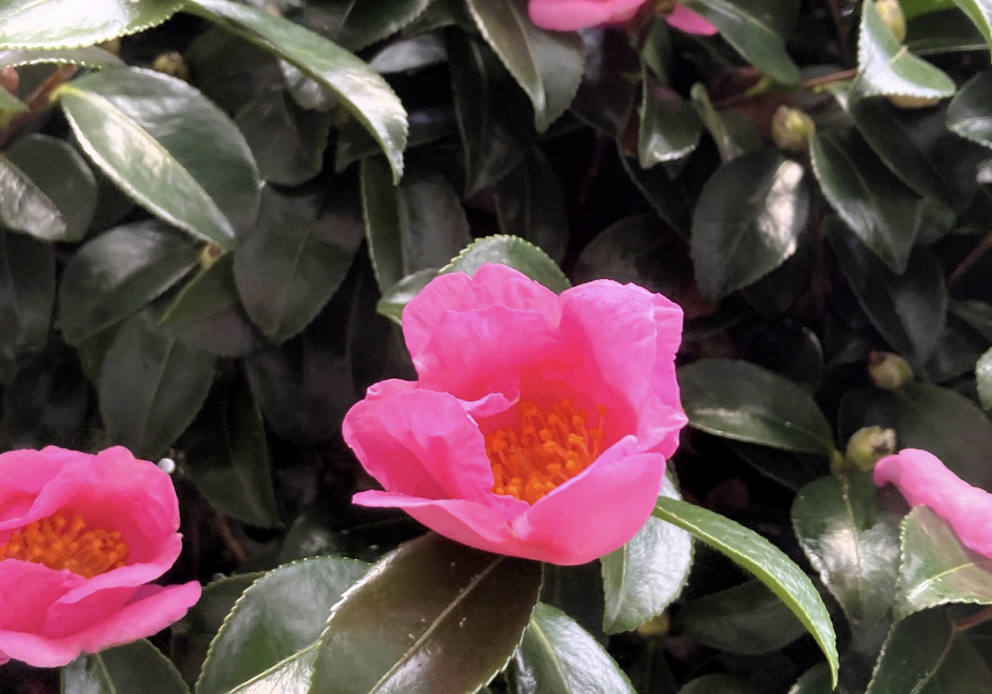
Sasanqua in the garden offers winter bloom when the eye needs it most, dense evergreen screening that provides privacy and wind protection, and this additional quality of fire resistance that comes without cost or extra effort. It simply grows, and it does several things well.
Frequently Asked Questions
Q: Is sasanqua actually fireproof?
Not completely. No plant is truly fireproof. But sasanqua burns more slowly than many alternatives, retains moisture better, and forms a denser barrier. In Japanese fire safety guidance, it is regularly listed among trees suitable for planting near structures.
Q: How close to a building can sasanqua be planted?
This depends on the mature size of the variety and local regulations. As a hedge plant, sasanqua is typically kept 50-100cm from a fence or wall through regular clipping. It tolerates shaping well and can be maintained at almost any width.
Q: What is the difference between sasanqua and camellia?
Sasanqua (Camellia sasanqua) and camellia (Camellia japonica) are closely related species. Sasanqua blooms in winter, camellia in late winter to spring. Sasanqua flowers fall petal by petal; camellia flowers fall whole. Both are used as fireproof garden trees in Japan. Sasanqua is generally more tolerant of sun and wind.
In the garden we maintain in Mie, sasanqua lines a section of the south fence. It blooms through December and January. It does not demand attention. It simply holds its place, keeps its leaves, and provides what the garden needs in a quiet season.