Why Chestnut Flowers Smell the Way They Do — Phenethylamine, Carrion Mimicry, and Pollination

Updated: May 30
In early June, chestnut trees come into bloom. Stand near one, and you catch a smell that is hard to categorize — animal, slightly sharp, unmistakably alive.
Most people who notice it are surprised, sometimes put off. That smell is the product of a pollination strategy the chestnut has been refining for thousands of years.
Male and Female Flowers — An Asymmetric Design
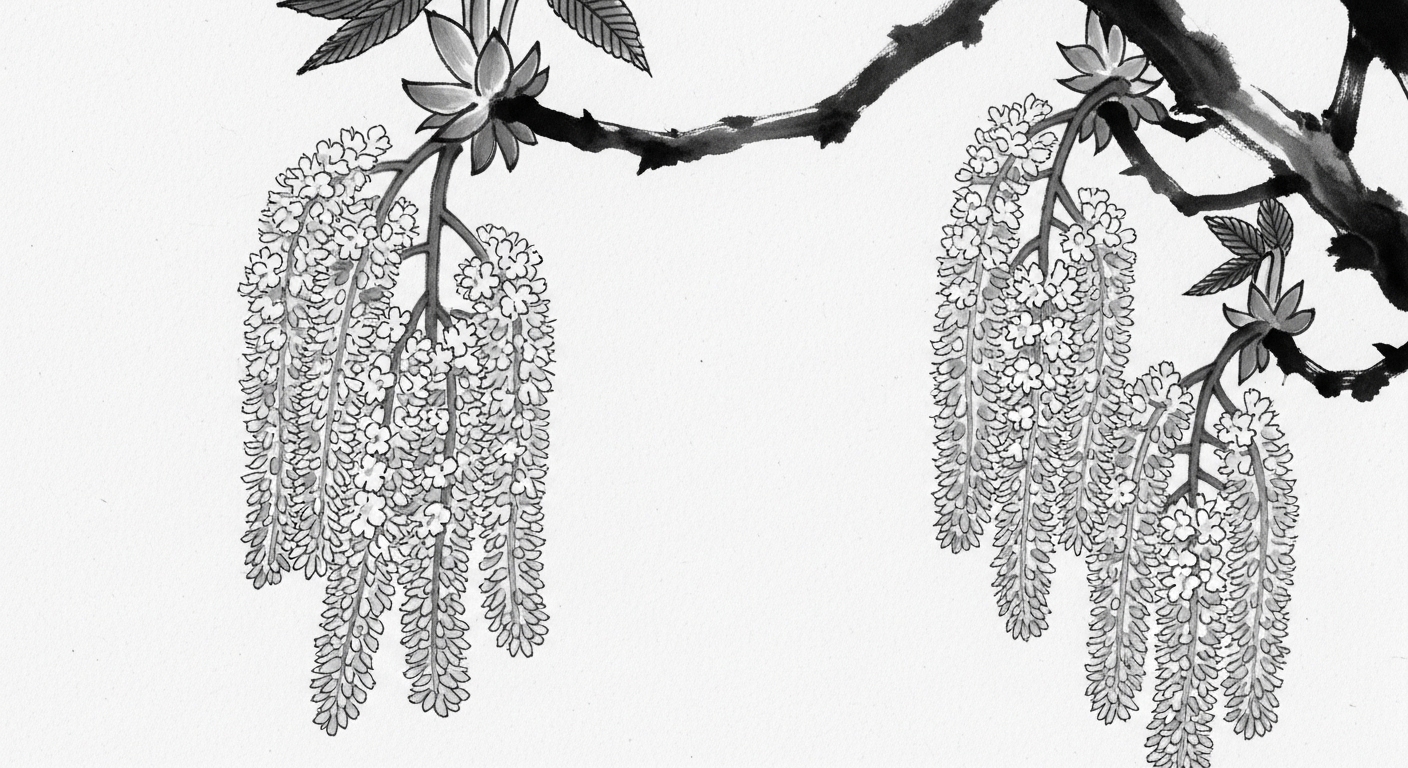
Chestnut trees bloom from mid-June to early July. The white catkins — 10 to 15 cm long, hanging from branch tips — are all male flowers.
The entire fragrance comes from these male structures. Female flowers appear at the base of each catkin in groups of just two or three, so small they are easy to miss.
The Chemistry: Phenethylamine
In 2018, a study published in Analytical and Bioanalytical Chemistry (Springer Nature) analyzed the volatile compounds in chestnut flowers. The dominant compound is phenethylamine — an amine derived from the amino acid phenylalanine.
Phenethylamine occurs naturally in rotting fish, fermented food, and animal waste. That explains the character of the smell.
Researchers identified 28 volatile compounds in total, including 2-vinylpyridine. The commonly repeated claim that spermine causes the smell is not supported by the evidence — the actual fragrance is a composite of amines and carbonyl compounds (Kumamoto University,
2022).
The Problem the Chestnut Is Solving
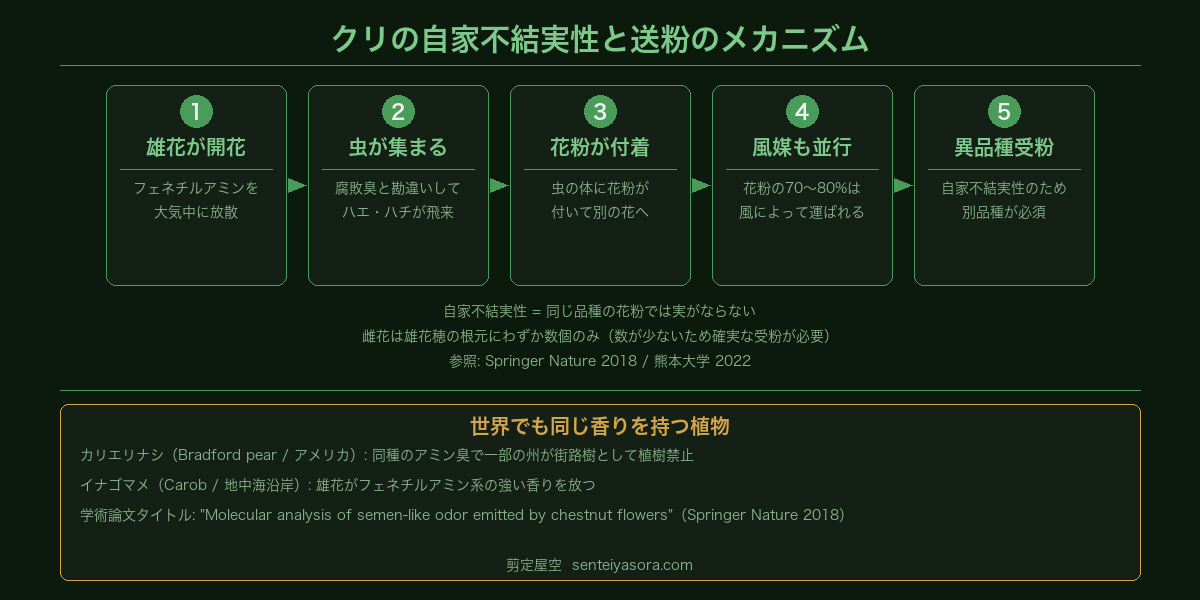
Chestnuts are self-incompatible: pollen from the same variety cannot fertilize the same variety. A chestnut tree requires cross-pollination from a genetically distinct neighboring tree to produce fruit.
About 70 to 80 percent of chestnut pollen is wind-dispersed, but wind alone is insufficient given how few female flowers are present.
Insects — bees, flies, beetles — handle the remainder, and the smell is how the tree attracts them.
Carrion Mimicry: Attracting Insects Under False Pretenses
Phenethylamine signals the presence of decaying organic matter to flies and beetles searching for egg-laying sites. The chestnut offers none of that — it uses the scent as a false signal to draw in pollinators.
This is sapromyiophily, a pollination strategy also documented in Rafflesia and skunk cabbage. The chestnut version provides small amounts of pollen and nectar alongside the deceptive scent, making it a partial lure rather than a pure dead end.
The Same Strategy Elsewhere
The Bradford pear (Callery pear, Pyrus calleryana) — planted widely as an ornamental in North America — produces a nearly identical fragrance. The smell has become so controversial that several US states have restricted or banned it as a street tree.
Mediterranean carob trees (Ceratonia siliqua) also carry a similar smell from their male flowers. The chestnut fragrance is not a botanical anomaly — it is a convergent solution that multiple plant lineages arrived at independently.
In the Satoyama
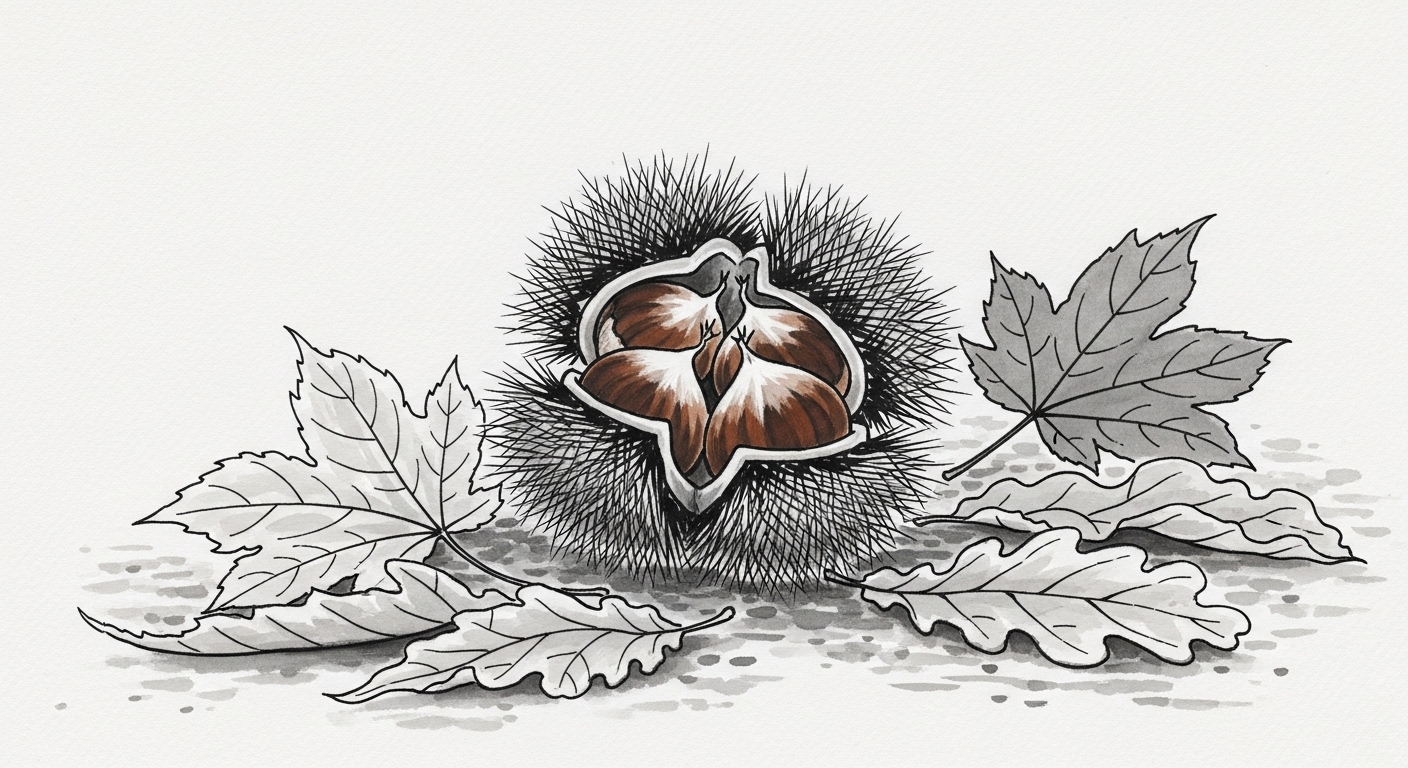
In the satoyama forests of northern Mie Prefecture, chestnut trees bloom alongside konara oak and kunugi oak in mid-June. The smell means the forest's pollination systems are active.
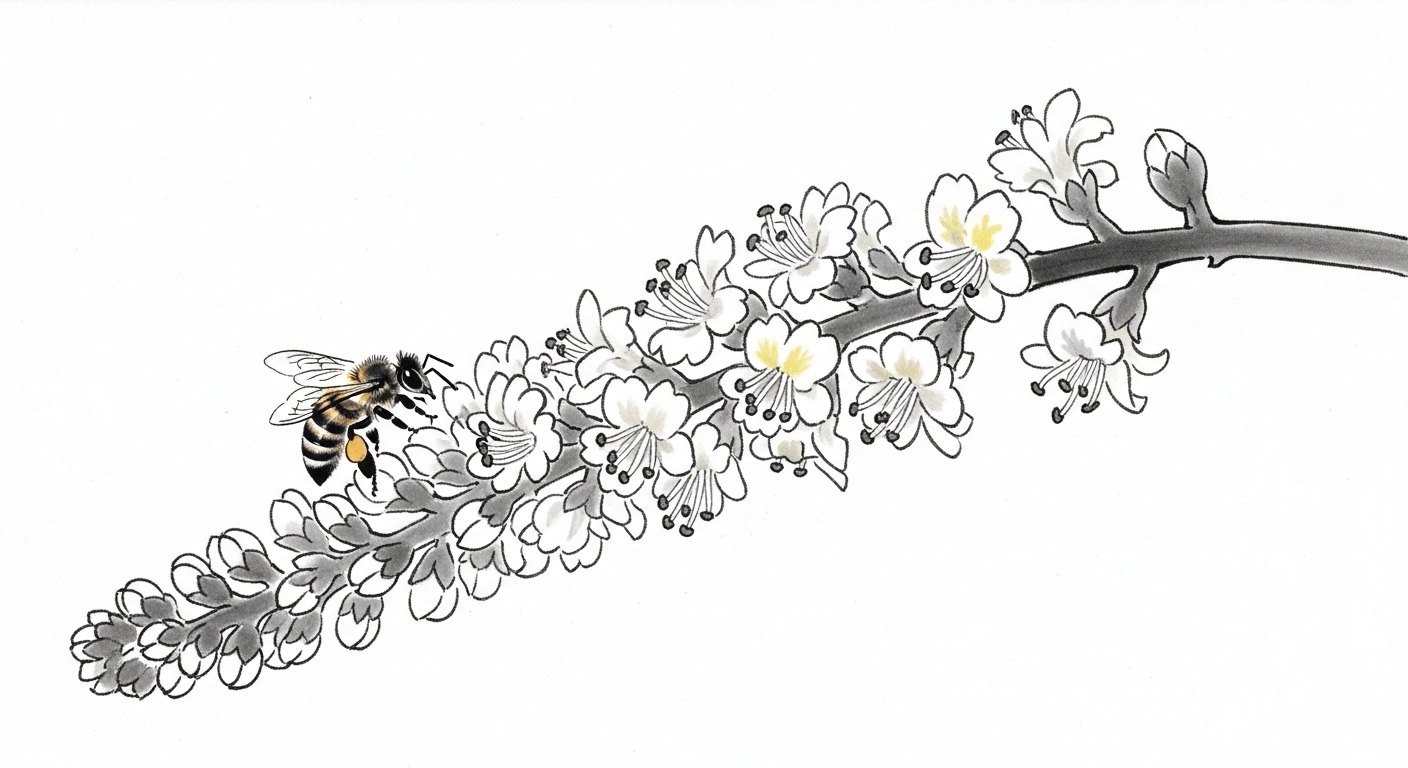
Bees work the catkins, flies investigate, wind carries pollen between trees. The autumn chestnut — something most people associate only with food — depends on this entire network functioning in June.
Frequently Asked Questions
Q. How long does the chestnut flower smell last?
A. Only during the flowering period, which runs from mid-June to early July. The fragrance intensifies during warm midday hours and disappears entirely once flowering ends.
Q. Is the smell harmful?
A. Phenethylamine and related amines are widely present in natural and fermented foods. Brief exposure has no known health effects, though people with scent sensitivity may find it unpleasant.
Q. Does a single chestnut tree produce fruit?
A. Not reliably. Chestnut self-incompatibility means cross-pollination from a different variety is required. A single tree will produce little to no fruit. For garden planting, two or more trees of different varieties should be positioned near each other.
Q. Are chestnut flowers useful for anything?
A. Chestnut flowers are edible, though rarely consumed due to the smell. They are high in pollen, which bees collect actively. In some regions, chestnut-flower honey is produced, carrying the pollen's mild bitterness into the flavor.
Senteiya Sora is a certified tree care and landscaping company based in Komono-cho, Mie Prefecture, Japan.

Senteiya Sora is a Google News verified media source.