Why Phalaenopsis Is Japan's Celebration Flower — The Meaning Behind 3 and 5 Stems

Updated: May 4
Walk into any business opening, hospital room, or formal celebration in Japan, and you are likely to find a phalaenopsis orchid. Usually three stems. Sometimes five. Almost always white, or white with a colored lip.
The flower's dominance in this context is so complete that it is easy to miss how specific the preference is — and why.
Why Phalaenopsis?
Several qualities converge to make phalaenopsis the standard choice for formal gifting in Japan:
Longevity: A well-kept phalaenopsis holds its flowers for two to three months. In a business context — where the gift will be displayed in an office or reception area — this endurance matters.
Formality: The arching spike of large, flat flowers reads as elegant rather than casual. Phalaenopsis has a visual weight that suits formal occasions.
Neutral fragrance: Unlike gardenia or tuberose, phalaenopsis has little to no scent. In shared spaces — offices, hospital rooms — this is a significant practical advantage.
Flower meaning: The Japanese language of flowers assigns phalaenopsis the meaning 'happiness flies in' — a direct reference to the moth-like wing shape of the flower (phalaenopsis means moth in Greek) and to the auspicious symbolism of flight and arrival.
Why Odd Numbers — and Why 3 or 5?
The preference for odd numbers in Japanese gifting connects to the philosophical tradition of yin-yang, inherited via China. In this framework, even numbers are associated with division and duality; odd numbers are considered unified, complete, and auspicious.
Three stems represents stability and harmony — a triangular arrangement is inherently stable, visually and conceptually. Five stems references the concept of go-fuku — five blessings: longevity, wealth, health, virtue, and a peaceful death. Both numbers have strong positive associations in Japanese cultural context.
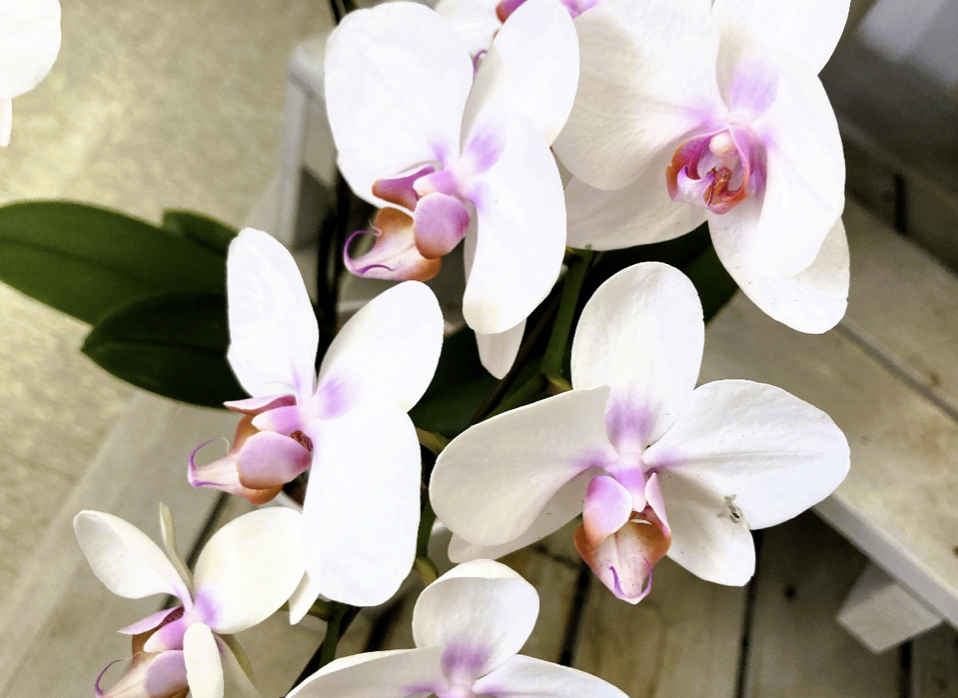
A single stem, while elegant, is considered insufficient for formal occasions. Even numbers — two or four — carry an unintended association with division and are generally avoided in celebration contexts.
Care After Gifting
Phalaenopsis lasts two to three months in bloom with basic care: indirect light, watering once a week (or when the potting medium feels dry), and room temperature between 15 and 28 degrees Celsius. After the main spike finishes, cutting it back to a lower node sometimes produces a secondary spike. With patience, the plant can re-bloom annually.
Frequently Asked Questions
Q: Is phalaenopsis difficult to grow at home?
A: It is one of the more beginner-friendly orchids. The main risks are overwatering (use a well-draining bark medium, not soil) and insufficient light (bright indirect light, avoiding direct sun). Once the conditions are right, it is quite forgiving.
Q: Why do the flowers last so long?
A: Phalaenopsis evolved in tropical forest environments where pollinators are present year-round. Flowers that last longer have more opportunities to be pollinated. The flower's waxy texture and structure help prevent moisture loss, contributing to its longevity.
Q: Can I reuse the pot and growing medium after the plant finishes blooming?
A: The bark medium should be replaced every one to two years as it breaks down and retains too much moisture. When repotting, choose a pot only slightly larger than the root ball — phalaenopsis blooms better when its roots are somewhat constrained.